
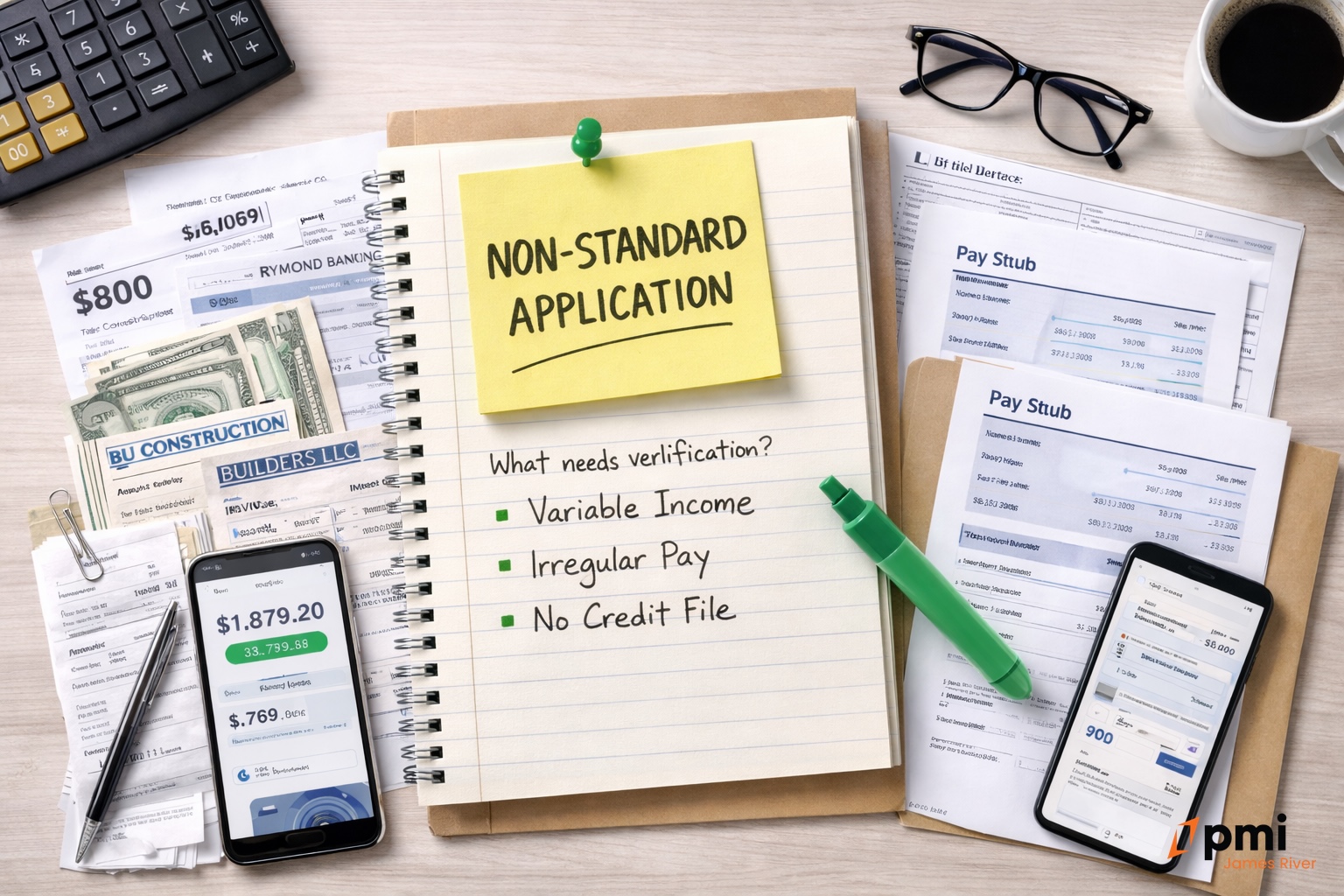
Non-standard rental applications are not rare in Virginia. A file may involve a new job, seasonal earnings, self-employment, a landlord who will not verify history, or a credit file that contains less information than expected. None of those facts automatically tells an owner whether the applicant will perform well under a lease.
PMI James River's tenant screening and risk control treats these files as evidence problems, not reasons to invent different qualification standards. The broader screening process framework explains why the workflow has to remain stable when an application falls outside the usual template.
The practical rule is simple: keep the qualification criteria fixed, then change only the proof path needed to verify those criteria. That creates room for legitimate non-standard files without turning screening into case-by-case intuition.
Key Takeaways
- For ordinary documentation variations, the evidence path can change while the applicable qualification rule stays the same.
- Alternative documents work best when they answer a specific missing question, such as whether income is current, recurring, and verifiable.
- A document that cannot be independently tied to the claim it is supposed to prove may leave the file unverified, even when the document looks credible.
- Virginia Fair Housing guidance favors written screening guidelines and consistent treatment across applicants.
- If a consumer report contributes to a denial or less favorable terms, Fair Credit Reporting Act adverse action requirements can apply.
In This Guide
- Change the proof path, not the standard
- What counts as non-standard documentation
- Proof paths for common non-standard files
- When alternative proof is not enough
- Fair Housing: tie the alternative to the missing evidence
- Consumer reports and adverse action
Change The Proof Path, Not The Standard
Direct answer. For an ordinary non-standard documentation issue, a file should not create a new screening standard for one applicant. It should trigger a defined way to prove the same information the normal file would have proved, unless a separate legal accommodation or mitigation process requires a different analysis.
That distinction matters. An income rule answers whether the applicant meets the income requirement. A proof rule answers what evidence is acceptable to establish that income. A rental-history rule answers what history is required. A proof rule answers how that history can be verified when a conventional landlord reference is unavailable.
PMI James River's current published rental qualification standards already use this structure. Bank-linked income verification is recommended, but manual verification can use qualifying documents such as pay stubs, tax returns, benefits letters, bank statements, or direct employer verification. The same page defines specific alternatives for new employees, self-employed applicants, seasonal income, home ownership, military housing, and prior landlords who will not provide a reference.
This is the useful boundary for owners: flexibility belongs in how a fact is proved, not in whether the fact has to be proved.
What Counts As Non-Standard Documentation?
For this article, "non-standard" means the normal proof package does not fit the applicant's situation cleanly. Common examples include:
- New employment. The job is real, but there is not yet a normal deposit history.
- Self-employment or gig work. Income arrives through business activity, contracts, or platforms rather than a conventional payroll cycle.
- Seasonal or variable earnings. One recent month does not represent the longer pattern.
- Unavailable landlord verification. A prior housing provider will not respond even though the applicant has records from the tenancy.
- Thin credit information. The report contains limited data, which is different from a report containing verified negative history.
Those are not all the same problem, and they should not be forced through one generic "exception" process. The general tenant screening evaluation framework owns the broader question of what screening evaluates across identity, income, credit, housing history, fraud, and documentation. This article addresses the narrower question of what to do when the normal evidence format does not fit.
Two nearby issues also deserve their own treatment. Applicants who lack standard U.S. records present cross-border verification questions covered in international applicant screening. Documents that appear altered, fabricated, or inconsistent raise a fraud question covered in fake pay stub verification. Keeping those jobs separate prevents every difficult file from becoming one oversized screening problem.
Proof Paths For Common Non-Standard Files
PMI James River's operating experience is that screening tends to break at the handoff between "this document is unusual" and "we still need to prove the same thing." A proof matrix keeps that handoff concrete.
| Scenario | What Still Needs To Be Proved | Possible Proof Path | What The File Note Should Capture |
|---|---|---|---|
| W-2 applicant declines bank linking | Current employment and recurring income | Recent pay records, matching deposit records, and employer verification when needed | Which sources were checked and whether pay cadence and deposits reconciled |
| New job or relocation | Position, compensation, and start date | Accepted offer documentation, direct employment verification, and any pay records already available | What was independently confirmed and what had not yet occurred |
| 1099, gig, or self-employed income | Amount, continuity, and connection between claimed work and actual deposits | Tax records plus recent bank records showing ongoing deposits consistent with reported income | The lookback period used and whether current deposits support continuity |
| Seasonal or variable income | A representative earning pattern rather than one strong month | A longer statement window when needed, with enough history to show the recurring pattern | Why the selected lookback period represents the income pattern |
| Prior landlord will not verify | Prior occupancy and payment history | Lease records and a complete, unedited ledger when available; ownership or military housing can be verified through their own records | What could be verified, what could not, and which substitute records were used |
The point is not to collect the largest possible file. It is to collect evidence that answers the missing question. More documents do not improve screening when they all repeat the same unsupported claim.
When a file falls outside the predefined categories, the safer operational move is a consistent escalation step rather than a one-off exception. The reviewer should identify what fact is still missing, choose evidence that can actually prove it, and document the reasoning before a decision is made.
When Alternative Proof Is Not Enough
Alternative documentation is not a promise that every file can be verified. Sometimes the correct conclusion is simply that the required fact remains unverified.
That can happen when documents contradict each other, deposits cannot be connected to the claimed income source, employment cannot be independently confirmed, records are incomplete, or follow-up evidence still does not resolve the gap. The screening decision should then rest on the written criteria and the verified record, not on how persuasive the explanation sounds.
This is where short contemporaneous notes matter. A useful note identifies the question, the evidence reviewed, the inconsistency or missing fact, the follow-up requested, and the final verification status. It does not need a narrative about the applicant's character.
PMI James River has seen screening breakdowns across income, rental-history, identity, and fraud checks when pressure encourages an exception or rushed decision. The management response is not harsher screening. It is a cleaner pause point: if the required fact is not verified, do not let approval momentum convert "pending" into "good enough."
Fair Housing: Tie The Alternative To The Missing Evidence
Virginia's Fair Housing Office advises housing providers that written screening guidelines and consistent treatment help reduce complaint risk. Its guidance also states that housing providers may request employment, income, and credit verification information as part of screening, while applying standards consistently. The current Virginia Fair Housing Office guidance is the right primary source for that state-level principle.
The practical control is to tie the alternative to the missing evidence. If the normal proof of current income is unavailable, the alternate path should be defined by what proves current income. If a landlord reference cannot be obtained, the alternate path should be defined by what can verify prior occupancy and payment history.
That is different from deciding who deserves more flexibility. PMI James River's operating rule is to make proof options depend on the verification problem, not on personal impressions. Consistency also does not mean ignoring a legally required accommodation or other separate mitigation process. Those issues belong in their own compliance analysis. The deeper Fair Housing and documentation framework covers that broader consistency problem.
Consumer Reports And Adverse Action
Alternative-document review and consumer-report compliance are related, but they are not the same thing.
The particular Fair Credit Reporting Act adverse action rule discussed here is tied to use of a consumer report. If a tenant screening report or other consumer report contributes to a denial or less favorable terms, the adverse action rules apply. The Consumer Financial Protection Bureau's tenant-screening guidance specifically lists denial, requiring a co-signer, or requiring a larger deposit as examples when report information drives the outcome.
The notice must identify the reporting company and explain the applicant's rights to obtain a free copy of the report within 60 days and dispute inaccurate information. The Federal Trade Commission's tenant background check guidance describes the same core protections.
The operational lesson is straightforward: document verification answers whether the applicant proved the qualification criteria. Consumer-report compliance answers what must happen when report information influences an unfavorable decision. Keeping those two questions separate makes both easier to administer correctly.
Frequently Asked Questions
Does A Non-Standard Application Mean The Screening Criteria Should Be Relaxed?
No. The cleaner approach is to keep the written criteria fixed and use an approved evidence path that can prove the same requirement in a different way.
Can Bank Statements Replace Pay Stubs?
Sometimes they can be part of manual verification, but a bank balance or unexplained deposit is not the same as recurring income. The useful question is whether the records can be tied to the claimed income source and show a pattern that supports the written requirement.
How Should A New Job Be Handled When There Are No Pay Deposits Yet?
PMI James River's published criteria allow current offer documentation for new employees and relocations. The file should distinguish what has already been independently verified from what has not yet occurred.
What If The Prior Landlord Never Responds?
A non-response should not be converted into a positive reference. PMI James River's current criteria allow substitute records such as a lease and complete, unedited ledger when a landlord will not provide rental verification. Ownership and military housing can also be verified through records appropriate to those situations.
Does A Thin Credit File Automatically Fail Screening?
No single conclusion should be drawn from the label alone. A thin file means less report data is available. The decision still has to follow the written credit criteria and the verified information that actually exists, rather than treating missing information as though it were proven negative history.
Final Takeaway
Non-standard screening becomes manageable when the owner separates eligibility from evidence. The qualification standard stays fixed. The proof path changes only enough to answer the missing verification question.
That structure can improve both sides of the decision. Legitimate applicants are not rejected merely because their records arrive in a different format, and owners do not have to accept weak evidence simply to keep a leasing timeline moving. The result is a process that can move good files forward while keeping the record consistent and explainable.
Next Step
For Richmond-area owners who want screening handled inside a documented leasing workflow, PMI James River's tenant screening service combines written criteria, verification, fraud controls, and application documentation before a placement decision is made.
Published: March 3, 2026
Updated: August 22, 2026