
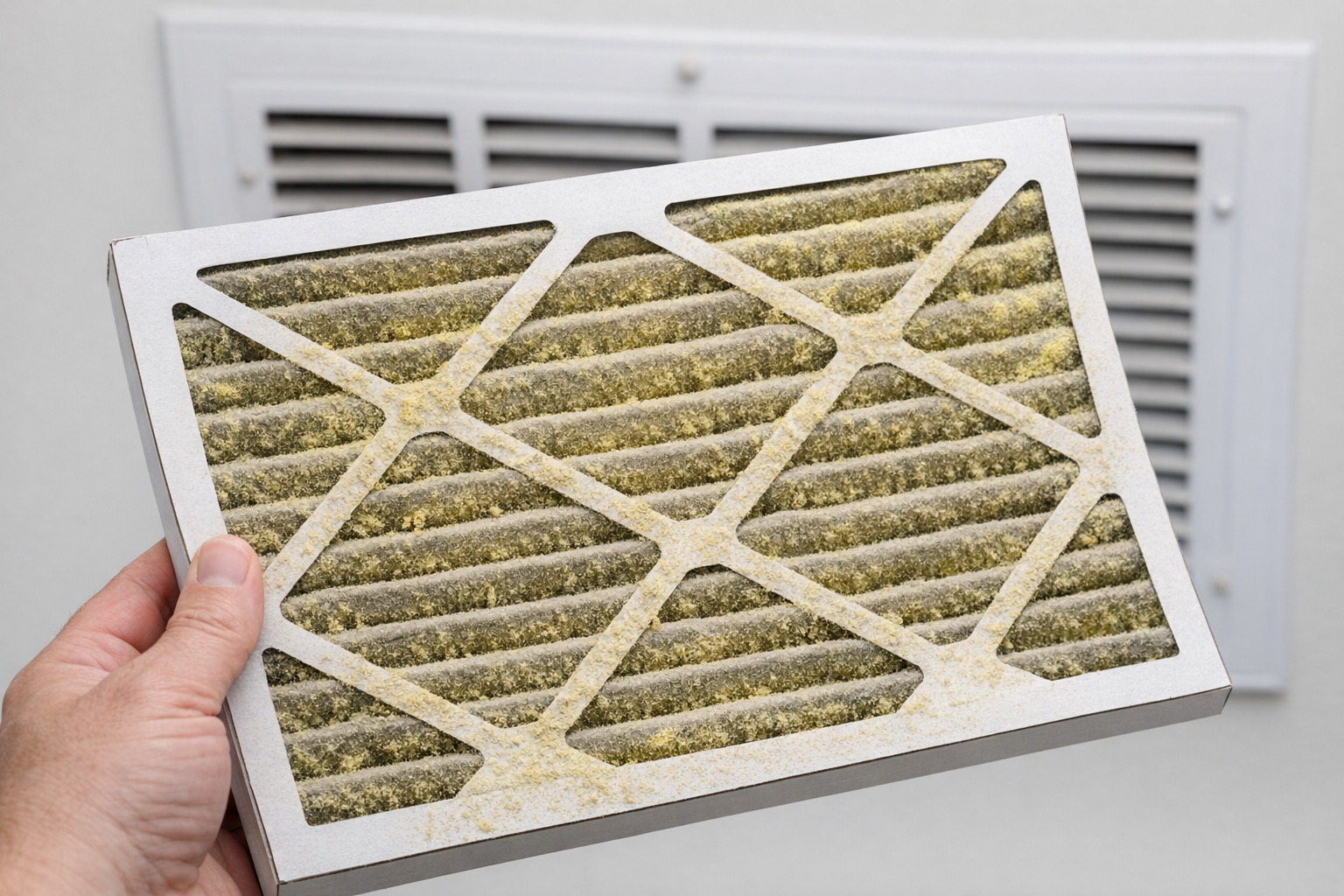
Richmond's spring pollen season can turn a simple HVAC complaint into a repeat service call if the first response focuses only on the thermostat. In many cases, the better starting point is airflow: check the filter, confirm that return and supply paths are open, compare temperatures, and look for moisture or icing before assuming the equipment has failed.
For rental owners, that approach fits into a broader maintenance process that separates a quick operating check from a true mechanical diagnosis. It also supports the same proactive maintenance framework used to catch manageable problems before peak summer demand makes scheduling harder.
At PMI James River, pollen-season complaints are handled as a pattern problem, not automatically as an emergency. The goal is to identify whether the complaint points to filter loading, restricted airflow, distribution, moisture, or an actual equipment problem, then leave a record that makes the next call easier to evaluate.
Key Takeaways
- Keep the 15 to 20 degree checks. They are useful screening tools, but they are not hard pass or fail rules.
- Outdoor-to-indoor temperature difference and return-to-supply temperature split are two different checks and should not be confused.
- A dirty or overly restrictive filter can reduce airflow and make a functioning system look weak.
- Whole-house weak airflow points in a different direction from a single hot room.
- Water near the air handler, icing, electrical problems, or complete loss of cooling should move the call beyond routine filter troubleshooting.
- Photos, temperature readings, and closeout notes reduce repeat visits and arguments about whether the same problem returned.
Start With Two Different Temperature Checks
A temperature check is useful because it gives the owner or property manager something more objective than "it feels hot." The important part is being clear about which temperature difference is being measured.
Outdoor-to-indoor difference: PMI James River uses roughly 15 to 20 degrees as a practical first reality check during very hot Richmond weather. If it is 95 degrees outside and the home is holding around 77 to 80 degrees inside, that difference by itself does not prove the air conditioner has failed. Building heat load, humidity, insulation, solar gain, duct losses, equipment sizing, and system condition all affect what the home can maintain. This is a screening check, not a promise that every house should always stay exactly 15 to 20 degrees below outdoor temperature.
Return-to-supply difference: A roughly 15 to 20 degree drop between return air and supply air is also a useful field check when the system has been running under normal conditions. It is a separate measurement. The Air Conditioning Contractors of America explains that the familiar 15 to 20 degree temperature split is a rule of thumb, not a universal diagnostic standard, because expected performance changes with airflow, indoor and outdoor conditions, sensible capacity, and manufacturer data. ACCA's temperature-split guidance is useful here because it explains why the number should inform the diagnosis without replacing it.
Key point: A 15 to 20 degree difference is worth checking. The mistake is treating either version of that check as a hard rule that proves the system is good or bad.
Check the Filter and Airflow Before Blaming the Equipment
During Richmond pollen season, filter condition belongs near the top of the checklist. ENERGY STAR notes that dirty filters restrict airflow, increase operating effort, and can contribute to equipment problems. Its current HVAC maintenance checklist recommends regular filter inspection and replacement and also calls for proper blower airflow, clean coils, and condensate-drain checks.
The filter with the highest rating is not automatically the best filter for every rental. EPA recommends using the highest-rated filter that the system fan and filter slot can accommodate, and notes that a technician may need to determine what a particular system can handle. That is especially important in rentals with older equipment, tight filter slots, limited return capacity, or recurring airflow complaints. EPA's residential filtration guidance supports matching filtration to the actual system rather than assuming more restriction is always better.
A practical first pass should record:
- Filter condition and filter type, preferably with a photo.
- Whether return grilles are blocked by furniture or other items.
- Whether supply vents are open and moving air.
- Whether the complaint affects the whole house or mainly one room.
- Outdoor temperature, thermostat setting, indoor temperature, and the time the system has been running.
- Return and supply temperatures when those readings can be taken reliably.
Use the Complaint Pattern to Decide What Comes Next
The symptom pattern usually tells the property manager whether to keep troubleshooting airflow or move quickly to an HVAC vendor.
- Whole-house weak airflow: Start with the filter, return path, blower, coil condition, and other restrictions. A filter change that produces a noticeable improvement is useful evidence, but the closeout should still record what changed.
- One room is much warmer: A filter may not be the main issue. Distribution, balancing, duct leakage, return placement, insulation, or solar gain may matter more.
- The system runs constantly but still cools somewhat: Compare the outdoor-to-indoor difference, then look at return-to-supply split and airflow before jumping to a major repair conclusion.
- Water near the air handler or drain pan: Treat the moisture separately from the comfort complaint. ENERGY STAR notes that a plugged condensate drain can contribute to water damage and humidity problems.
- Icing, tripped breakers, burning smells, unusual electrical behavior, or no cooling: Move beyond routine filter troubleshooting and route the call for professional diagnosis.
If the same property repeatedly produces marginal airflow or cooling complaints, the issue belongs in the property's maintenance history rather than being restarted from zero each spring. The broader peak-season HVAC failure-prevention guide addresses what to do when repeat symptoms start creating scheduling and reliability risk.
Richmond Pollen Season Changes the Timing, Not the Physics
The HVAC principles are the same across Richmond Metro, but the buildings are not. Older Richmond City homes may have limited return pathways, retrofitted ductwork, or additions that make airflow problems show up differently from newer suburban homes in Henrico or Chesterfield. Hanover rentals can present another mix of equipment age, crawl-space ductwork, and seasonal outdoor loading. The point is not that one jurisdiction has "better" or "worse" HVAC. The point is that the same complaint can have a different cause depending on the house.
That is why PMI James River does not use one filter schedule or one temperature number as a universal answer. Spring pollen is one part of the broader Richmond rental maintenance calendar. A property with a history of rapid filter loading or weak airflow may justify more frequent checks before summer, while another property may perform well on a normal schedule.
Once sustained heat and humidity arrive, the troubleshooting emphasis also changes. The separate guide to summer HVAC and humidity problems covers condensate, humidity, long run times, and the conditions that become more important after pollen season.
Document the Call So the Next Complaint Starts With Evidence
A filter replacement is easy to record poorly. "Changed filter, system working" does not tell the next technician or property manager much.
A stronger closeout records what was reported, what was observed, what temperature checks were taken, what filter was installed, whether airflow improved, whether moisture or icing was present, and whether anything remained unresolved. When the same complaint returns, those notes make it easier to tell whether the problem is recurring, new, or simply being described differently.
This is also where owner cost control improves. Good intake information can prevent a technician from arriving with no useful history, while a good closeout can prevent the next dispatch from repeating work that was already done. In peak season, avoiding one unnecessary repeat trip may matter as much as the price of the filter itself.
Common Mistakes During Pollen Season
- Removing the 15 to 20 degree check because it is not a perfect rule instead of using it as a clearly labeled screening tool.
- Confusing outdoor-to-indoor temperature difference with return-to-supply temperature split.
- Installing a higher-restriction filter without considering what the system can actually handle.
- Assuming every weak-cooling complaint is a refrigerant or equipment failure before checking airflow.
- Assuming every one-room complaint is a whole-system problem.
- Ignoring water or condensate symptoms because the resident originally reported a comfort issue.
- Closing the work order without readings, photos, or verification notes.
FAQ
How often should an HVAC filter be changed during Richmond pollen season?
There is no single schedule that fits every rental. Filter type, system design, run time, pets, indoor dust, renovation residue, and outdoor particle load all affect how quickly a filter loads. Check the filter regularly and shorten the replacement interval when it is visibly loading faster than expected.
Does a 15 to 20 degree outdoor-to-indoor difference mean the HVAC is working correctly?
Not by itself. PMI James River uses it as a practical first check during hot weather, not as a pass or fail standard. A home that is roughly 15 to 20 degrees cooler than outside may still have a problem, and a home with a smaller difference may have an explanation unrelated to equipment failure. The number has to be read with the building conditions and complaint pattern.
Does a 15 to 20 degree return-to-supply split prove the system is healthy?
No. It is another useful check, but ACCA cautions against treating the familiar 15 to 20 degree split as a universal diagnosis. Airflow, indoor and outdoor conditions, equipment data, and other operating factors matter.
Can a better filter make cooling worse?
It can if the filter creates more resistance than the system can handle. Higher filtration can be valuable, but filter efficiency has to be matched to the fan, filter slot, return capacity, and replacement schedule.
When should a pollen-season complaint become an HVAC service call?
Professional diagnosis is appropriate when basic airflow checks do not explain the problem, the system cannot maintain reasonable conditions, the temperature pattern is abnormal, or there are warning signs such as icing, water, electrical problems, unusual noises, or complete loss of cooling.
Conclusion
Pollen season does not require Richmond rental owners to treat every weak-cooling complaint as a major HVAC failure. It does require a repeatable first response. Check the filter and airflow, use the 15 to 20 degree temperature differences as practical screening tools, separate whole-house problems from room-specific complaints, and escalate moisture or mechanical warning signs quickly.
For owners who want that intake, vendor coordination, documentation, and follow-through handled consistently, PMI James River's Richmond property management service includes maintenance coordination as part of the operating system for the rental.
Published: May 26, 2026
Updated: August 22, 2026