A rental kitchen does not need custom cabinetry or a remodel to work better. The most useful purchases are portable, adjustable, and easy to take to the next home. That matters in Richmond Metro, where residents can move between homes with very different counter space, cabinet dimensions, sink layouts, and storage.
At PMI James River, our rule is simple: solve the recurring kitchen problem, not one specific cabinet. The same idea runs through our broader guide to living well in a Richmond rental. A good renter purchase should make daily life easier now without becoming useless after the next move.
We have linked examples so you can see the type of product we mean. They are illustrations, not brand endorsements. Measure your space, compare options, and choose the version that fits your kitchen and how you actually cook.
Rental-kitchen rule: Favor items that solve a real annoyance, need little or no installation, and can work in more than one kitchen.
What Makes a Rental-Kitchen Essential?
An "essential" is not something every renter has to own. It is something that solves a common kitchen limitation without creating a new problem. Think poor task lighting, not enough prep space, deep cabinets, wasted vertical space, or too many single-purpose appliances competing for the same counter.
That is also what separates this list from our guide to renter-safe upgrades in Richmond. If a project needs drilling, permanent hardware, strong adhesive, or a change to the home itself, it belongs in a different category. The ten ideas below are meant to stay portable.
Create More Usable Space
1. Rechargeable Task Lighting
A ceiling light can leave the countertop in shadow, especially when the fixture is behind the person doing the chopping. A rechargeable under-cabinet light puts light closer to the work surface without adding permanent wiring.
Look for a version that can sit, clip, or magnetically attach without screws. If a model needs adhesive mounting plates, check the surface and removal method before treating it as a renter-friendly option.
Example: rechargeable magnetic under-cabinet light.
2. A Cutting Board That Spans the Sink
When counter space is tight, an over-the-sink cutting board can temporarily turn part of the sink opening into prep space. Measure the sink first and choose a board designed to rest securely on the edges. It should feel stable before a knife ever touches it.
Use the sink version for the sink. Do not turn the stovetop into storage or prep space. The U.S. Consumer Product Safety Commission's kitchen fire guidance says to keep stovetops clean and clear and keep flammable items away from hot surfaces.
Examples: over-the-sink cutting boards.
3. A Sturdy Rolling Kitchen Cart
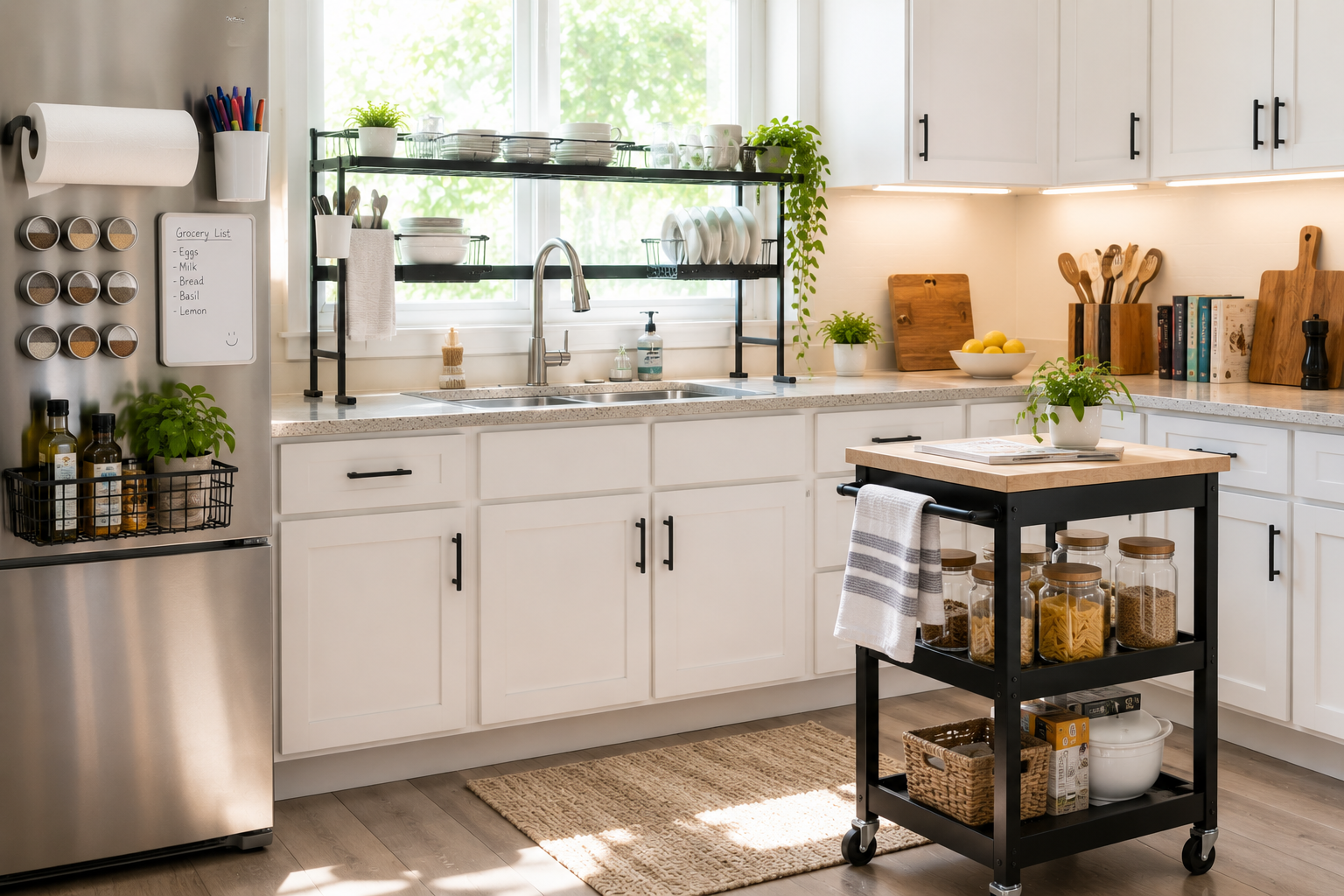
A rolling cart is useful because its job can change with the kitchen. It can hold pantry goods in one home, become a coffee station in the next, or provide a landing spot for appliances and cookware somewhere else.
Choose a stable cart with wheels that lock or stay put when loaded. If it will double as a prep station, place a food-safe cutting board on a stable top rather than assuming the cart surface itself is meant for direct food preparation.
Example: IKEA RÅSKOG utility cart.
4. An Over-the-Sink Drying Rack
A traditional dish rack can take over a surprising amount of counter space. An over-the-sink rack shifts that function to space the sink is already using and lets water drain where it belongs.
Measure sink width, faucet height, and the space needed to use the faucet comfortably. A rack that looks compact online can still be awkward if it fights the faucet every time someone washes a glass.
Example: OXO over-the-sink dish rack.
Make Rental Cabinets Work Harder
5. Freestanding Shelf Risers
Tall cabinet openings often waste vertical space. A shelf riser creates a second level so plates, bowls, mugs, or pantry goods do not have to become one unstable stack.
For renters, freestanding beats fitted. Measure the cabinet's width, depth, and usable height, then choose a riser that can move to another shelf or another kitchen later.
Example: IKEA VARIERA shelf insert.
6. A Portable Lazy Susan
A freestanding turntable is one of the simplest fixes for bottles and jars that disappear at the back of a cabinet. Oils, sauces, spices, condiments, and baking ingredients stay visible because the back of the shelf can rotate toward you.
No corner cabinet is required. Just make sure the diameter works with the shelf and that taller bottles will clear the shelf above.
Example: IKEA VARIERA Lazy Susan.
7. A Vertical Organizer for Pans, Boards, and Lids
If removing one baking sheet starts a small avalanche, stop stacking flat kitchen gear. A freestanding vertical organizer stores pans, trays, cutting boards, cooling racks, and lids more like files.
An adjustable rack is usually more useful than a highly specialized organizer because the spacing can change when the cookware or cabinet changes.
Example: YouCopia StoreMore bakeware rack.
8. Freestanding Slide-Out Cabinet Drawers
Deep lower cabinets can hold plenty and still make half of it hard to reach. A freestanding slide-out drawer or bin brings the contents forward without installing permanent pull-out cabinetry.
These are especially useful for pantry goods, cleaning supplies, or small kitchen items that otherwise disappear behind whatever is in front. Check cabinet depth and any plumbing before buying an under-sink version.
Example: tool-free two-drawer cabinet organizer.
Use the Space You Already Have
9. Magnetic Refrigerator Storage
If an exposed side of the refrigerator is magnetic, it can become useful vertical storage without drilling a wall. A small shelf, basket, hook, or paper-towel holder can move frequently used items off the counter.
Check the actual refrigerator surface before ordering. Not every exterior panel is magnetic, and the point is to solve a storage problem, not collect magnetic accessories.
Example: magnetic side-of-fridge organizer.
10. One Countertop Appliance That Does Several Jobs
Small kitchens punish single-purpose appliances. If one machine can realistically replace two or three appliances that a resident actually uses, it may earn its counter space better than several separate devices.
The important word is actually. A combination appliance is not a space saver if its extra functions never get used. Compare the appliance to the way the household cooks, not the number of functions printed on the box.
Countertop appliances also need sensible placement and use. The CPSC Home Electrical Safety Checklist recommends unplugging countertop appliances when they are not in use, keeping cords away from hot surfaces, and keeping appliances away from the sink or using appropriate GFCI protection.
Example: Cuisinart air-fryer toaster oven with grill.
Buy for This Kitchen and the Next One
The best rental-kitchen purchases are not the ones that perfectly fit one awkward cabinet. They are the ones that solve a recurring problem and can adapt when the kitchen changes.
That is especially practical across Richmond City, Henrico, Chesterfield, and Hanover, where one move can mean a completely different kitchen footprint. Portable lighting, movable storage, shelf inserts, a rolling cart, and flexible organizers can all keep doing useful work without becoming part of the property.
For more everyday rental ideas, browse our Richmond renter lifestyle tips. PMI James River residents can also find portals, forms, maintenance information, and other tools on our Resident Resources page.
Published: August 7, 2026 | Updated: August 23, 2026