
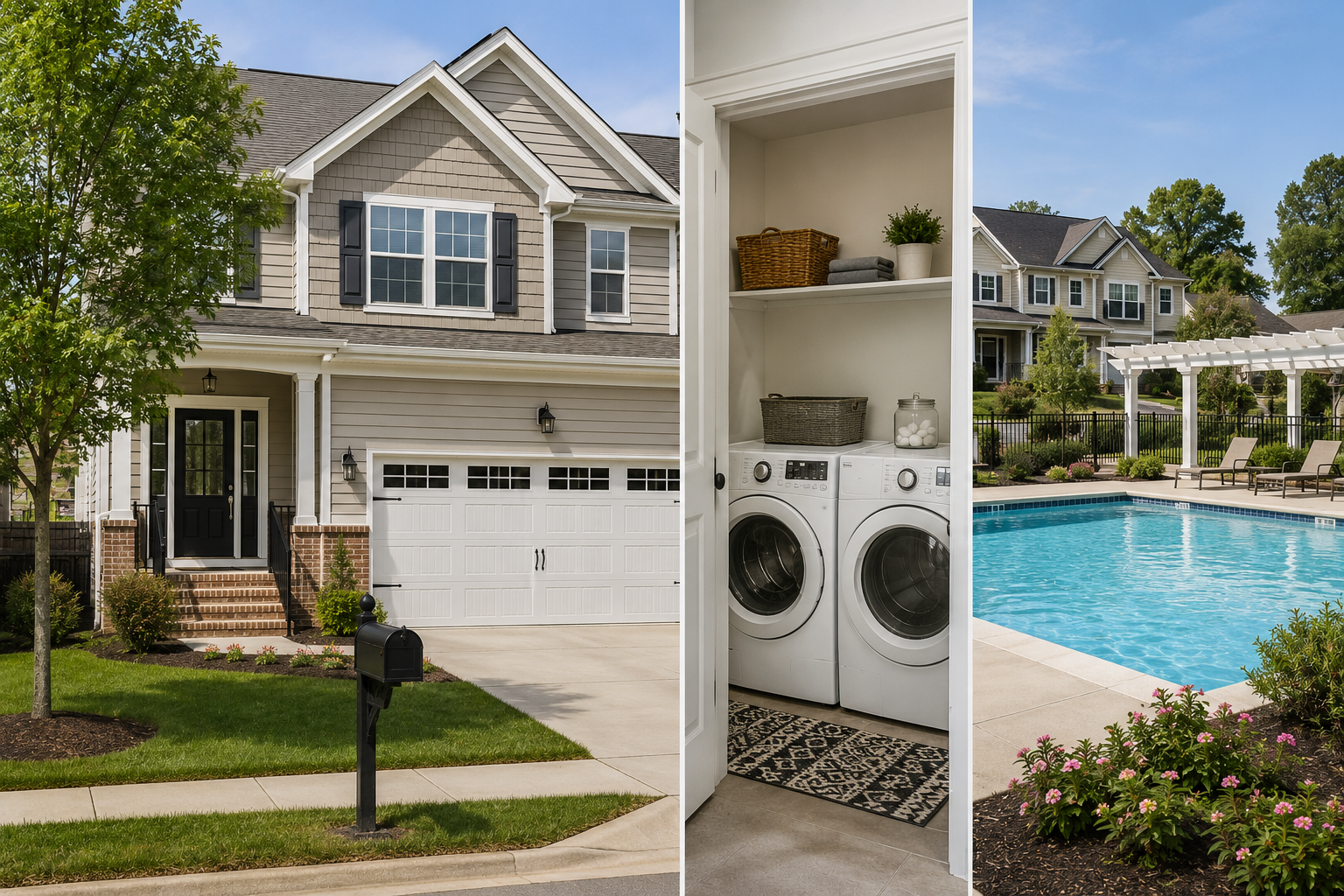
Rental-property owners often ask one question about a feature: "How much more rent will this get me?" In the Richmond Metro, that is only part of the calculation. A feature can support a higher monthly rent, but it can also make a home easier for qualified renters to choose. That second effect may show up in saves, shares, inquiries, applications, a broader prospect pool, or a shorter leasing period.
That distinction matters when an owner is deciding whether to provide a washer and dryer, favor a property with an attached garage, pay for a community with a pool, or change a restrictive pet policy. PMI James River's Richmond rental marketing process treats leasing speed as part of the economics, while our guide to what a Richmond property will rent for explains how market evidence sets a supportable rent range. This article addresses the narrower owner decision: how much weight should a feature receive when rent evidence and renter demand do not point to the same number?
Key Takeaways
- A demand signal is not a rent adjustment. More saves, shares, inquiries, or applications can matter financially without proving a specific monthly premium.
- In Richmond single-family rentals, PMI James River gives practical features such as in-unit laundry and off-street parking more weight than many luxury-style amenities because they can affect whether a prospect keeps a home in consideration.
- National apartment studies are useful evidence, but they should not be applied mechanically to Richmond-area detached homes.
- Vacancy math matters. A modest improvement in renter demand can have real economic value even when the direct rent premium is small.
- Feature values should not be stacked. Garage, laundry, bedroom count, condition, age, location, and community amenities often travel together.
In This Guide
- Two Ways a Feature Can Pay
- Laundry and Parking Show Demand Value
- What National Research Can Tell a Richmond Owner
- Pools Show Why Local Context Matters
- Vacancy Math Can Change the Answer
- PMI James River Working Richmond Ranges
- A Two-Channel Feature Test
Two Ways a Feature Can Pay
The cleanest way to evaluate a rental feature is to separate price value from demand value.
Price value asks whether comparable properties with the feature support a higher rent after accounting for the major factors that also move price, including location, housing type, size, bedroom count, condition, age, and timing.
Demand value asks whether the feature removes an objection, matches a common search preference, broadens the prospect pool, or makes the home more competitive against similar alternatives.
The two can move together, but they do not have to. A renter may strongly prefer in-unit laundry without paying another $150 per month for it. A garage may help one house win against another even when the final rents are close. A community pool may matter in one Chesterfield or Midlothian competitive set and have little effect in another.
| Evidence Type | What It Measures | What It Does Not Prove |
|---|---|---|
| Modeled listing-rent association | How advertised rents differ after statistical controls | That the feature caused the difference or that the same premium applies locally |
| Stated willingness to pay | What surveyed renters say a feature is worth | What an executed lease will actually achieve |
| Listing engagement | Views, saves, shares, inquiries, or other interest signals | A monthly rent premium or a guaranteed reduction in vacancy |
| Leasing-speed association | Whether listings with one characteristic leased sooner in observed data | That the same number of days will apply to a specific Richmond property |
| Local comparable pattern | How similar nearby rentals appear to price and compete with the feature | A universal adjustment that can be added to every property |
This is also why a rent-ready decision should not become a generic renovation list. The owner needs to identify the feature that solves a real market constraint at a sensible cost.
Laundry and Parking Show Demand Value
In-unit laundry and parking are useful examples because the evidence is unusually consistent about renter interest, even though it does not produce one universal rent adjustment.
A 2024 Zillow Rentals analysis of nearly 5.6 million listings, including apartments and single-family houses, found that listings mentioning off-street parking received 85% more saves and 103% more shares per day. Listings mentioning in-unit laundry received 76% more saves and 92% more shares per day. Zillow used multiple regression and controlled for home type, region, listing month, rent, rent per square foot, and whether 226 different features appeared in the listing description.
That is strong evidence that these features are associated with listing engagement. It is not evidence that off-street parking adds a fixed dollar amount to every Richmond lease.
A 2026 Apartments.com survey of 14,066 U.S. renters points in the same direction. In-unit laundry nearly tied air conditioning as the most common must-have, while 42% of respondents identified off-street parking or a garage as a must-have.
PMI James River sees the same practical distinction in Richmond single-family rentals. When comparable homes provide in-unit laundry or off-street parking, a home without the feature can lose prospects even when the missing feature does not support a clean monthly rent premium. The owner may then have to compete harder through price, condition, layout, location, or another advantage.
What National Research Can Tell a Richmond Owner
National research can help establish direction and scale. It cannot replace direct Richmond-area comparables.
In 2024, ApartmentAdvisor analyzed more than 250,000 apartment listings with a regression model controlling for location, square footage, bedrooms, and bathrooms. Its nationwide model associated an in-unit washer and dryer with a 5.57% higher listing rent, garage parking with 8.02%, and a pool with 3.24%. Using the report's national one-bedroom median, those modeled effects were about $84 per month for in-unit laundry and $121 per month for a garage.
The same study gives owners an important warning: individual amenity values should not be added together. Amenities often appear in bundles, and building age, class, location, and other property characteristics can overlap with the feature being measured.
A different kind of evidence comes from the 2022 Grace Hill/NMHC Renter Preferences Survey. Among 221,000 renters in 79 markets, 92% expressed interest in in-unit laundry and reported $54.73 per month in willingness to pay. That is useful as stated renter preference, but it is not an observed Richmond lease premium.
Housing type matters even more. Zillow's 2025 Consumer Housing Trends Report found that recent renters choosing single-family detached homes put heavy weight on the fundamentals: 94% considered staying within their initial budget essential, 83% said preferred bedroom count, 72% said preferred bathroom count, and 74% said layout. By comparison, 39% called common building amenities essential.
That is why a detached rental in Henrico County should not be valued as a larger version of a one-bedroom apartment. Bedroom utility, yard, parking, pet policy, layout, condition, and location fit can carry more weight. National apartment percentages can help frame the question, but the Richmond competitive set has to answer it.
Pools Show Why Local Context Matters
Pool data shows why one national number should never become an automatic adjustment.
A 2019 HotPads analysis of the 50 largest U.S. metros found that rentals mentioning pool access were associated with an average premium of $70 per month, or 4.5%. In the Richmond metro, the reported association was $92 per month, or 6.2%.
The result is locally interesting, but it has clear limits. The analysis is from 2019, combines housing types, and does not cleanly separate a private pool from community-pool access. Pool mentions were also much more common in multifamily listings than in single-family listings.
More recent sources measure different outcomes. Zillow's 2024 listing-engagement analysis found traditional amenities such as pools drawing less engagement than practical features such as parking and laundry after its controls. The 2026 Apartments.com renter survey found only 12% of respondents called a pool a must-have. ApartmentAdvisor's 2024 model still associated pools with a 3.24% higher apartment listing rent.
Those findings measure different things. A pool can be part of a higher-priced amenity package without independently creating the strongest listing engagement. In Richmond-area single-family rentals, community-pool access can also matter more inside a planned community where comparable homes offer the same type of amenity package.
The practical owner question is therefore local: how do otherwise similar competing rentals with and without pool access price and lease in this specific submarket?
Vacancy Math Can Change the Answer
Rent premium is only one path to a return.
A $75 monthly premium is $900 per year. On a $2,500 monthly rental, 15 vacant days represent roughly $1,250 in gross rent exposure. That does not mean a washer and dryer, garage, pool, or other feature will prevent 15 vacant days. It gives the owner a common dollar framework for comparing a modest rent premium with the possible value of stronger renter demand.
Pet policy provides a useful example because Zillow measured both engagement and leasing speed. Its 2025 analysis of more than 11 million rental listings found that pet-friendly listings typically rented eight days faster and received 9% more views, 12% more saves, and 11% more shares than listings that did not allow pets. Zillow's 2025 Consumer Housing Trends Report separately found that 69% of recent single-family detached renters considered allowing pets essential.
Pet policy is not a physical amenity, and those results do not prove that laundry or parking creates the same leasing-speed effect. They do show why demand value belongs in the owner's economic analysis. The broader Richmond rental pet-policy decision also includes separate risk, insurance, HOA, screening, and accommodation considerations.
For a Richmond owner, a missing feature or restrictive policy may become visible in the leasing funnel before it becomes visible in the final rent. Repeated questions about laundry, parking, pets, or another missing feature followed by lost prospects are operating evidence. That belongs in the same review used to diagnose why a Richmond rental is not leasing.
PMI James River Working Richmond Ranges
Published national studies are often too broad to isolate one feature in a Richmond-area detached home. PMI James River therefore maintains working feature values from local rental analysis. The ranges below were updated in August 2026. They are moderate-confidence working estimates, not appraisal adjustments, published-study findings, or guaranteed rent premiums.
| Feature | PMI James River Working Range | Evidence Strength | How to Use It |
|---|---|---|---|
| Additional bedroom, 3BR to 4BR, newer detached-home cohort in East Henrico | About +$150/month | Moderate | Use as a segment comparison for similarly sized and aged homes, not a universal bedroom adjustment. |
| Washer and dryer included in suburban detached rentals | About +$50 to +$75/month | Moderate | Test against direct local comps and the full installed and lifecycle cost of supplying the machines. |
| Attached garage | About +$100 to +$150/month | Moderate | Compare similar detached homes where parking, storage, age, condition, and location are otherwise close. |
| Community pool access in Chesterfield/Midlothian planned communities | About +$100 to +$150/month | Moderate | Use only where competing communities, housing type, and the broader HOA amenity package are genuinely comparable. |
The most important rule is do not stack these ranges mechanically. A newer four-bedroom home may also be more likely to have a garage, included laundry, better storage, newer finishes, and community amenities. Adding every individual range can count the same underlying quality advantage more than once.
The ranges are most useful as diagnostic flags. If direct local comparables with garages consistently support more rent, the feature deserves weight. If those same homes are also newer, larger, better finished, and inside a stronger amenity package, the garage should not receive credit for the entire rent difference.
A Two-Channel Feature Test for Richmond Owners
Before paying for an improvement, choosing between acquisitions, or using a feature to justify a higher asking rent, PMI James River uses a two-channel, five-check test.
1. Test the Demand Channel
Does the feature remove a recurring objection or match a common search preference? Look at listing filters, inquiry questions, showing feedback, lost-prospect patterns, and the competing homes a renter can choose instead.
2. Test the Rent Channel
Do direct comparable rentals support a higher asking or achieved rent for homes with the feature? The closer the comps are in location, housing type, size, age, condition, and timing, the more useful the comparison becomes.
3. Match the Evidence to the Property Type
Apartment research can be useful for a single-family owner, but it is usually directional. A detached home in the Richmond suburbs competes on bedroom utility, layout, yard, parking, pet policy, storage, condition, and seasonal timing in ways that a one-bedroom apartment does not.
4. Price the Full Cost
Include acquisition or installation cost, maintenance, replacement, HOA cost where relevant, and the operational responsibility the feature creates. For owner-provided laundry, PMI James River generally favors new, basic, dependable machines over used or feature-heavy models. The relevant cost includes delivery, installation, required parts, repair risk, eventual replacement, and haul-away. A cheap used set that fails early can erase a modest rent advantage quickly.
5. Compare the Premium With Vacancy Exposure
Translate the possible annual premium and the property's daily vacancy exposure into dollars. The calculation does not assume the feature will eliminate vacancy. It gives the owner one unit for comparing two different forms of economic value.
Finally, apply the non-stacking rule. When several desirable features appear together, treat them as a package until direct evidence supports separating them. That keeps the rental analysis tied to the actual competitive set instead of turning it into a menu of unsupported add-ons.
Frequently Asked Questions
Does In-Unit Laundry Always Raise Rent?
No. ApartmentAdvisor's national apartment model, the Grace Hill/NMHC renter survey, Zillow's listing-engagement analysis, and PMI James River's Richmond working ranges all point to value in in-unit laundry, but they measure different things. The Richmond rent effect still depends on housing type, condition, competing properties, and whether renters already expect laundry at that price point.
Is a Garage Worth More Than Off-Street Parking?
Often, but not automatically. ApartmentAdvisor's national apartment model associated garages with a larger rent effect than generic parking, while Zillow found very strong engagement for off-street parking. PMI James River's current Richmond working range for an attached garage is about $100 to $150 per month in comparable suburban detached homes, with moderate confidence. Direct local comps should still control the final adjustment.
Does a Community Pool Raise Rent in Richmond?
It can. PMI James River's current working range is about $100 to $150 per month for community-pool access in genuinely comparable Chesterfield/Midlothian planned-community detached rentals, with moderate confidence. The range should not be applied outside that context. National sources also disagree on the strength of pool value because they measure different housing types and outcomes.
Should an Owner Add a Feature Just Because Renters Want It?
No. Renter interest is one input. The owner should compare demand value, rent value, installation or acquisition cost, maintenance, useful life, operational responsibility, and whether the feature has become a baseline expectation among competing rentals.
The Best Feature Solves the Actual Constraint
The most valuable rental improvement is not always the one with the largest theoretical rent adjustment. A feature can improve the economics because it supports rent, broadens demand, removes a recurring objection, or helps the property compete without relying as heavily on concessions or price reductions.
That distinction matters in the Richmond Metro because a detached home in Henrico or Chesterfield can compete very differently from a large apartment community in Richmond City. The owner needs to know what the closest competing rentals offer, what direct local comps support, what prospects are responding to, and what the feature costs to own over time.
The useful question is simple: Will this feature improve the total economics of this rental?
Next Step
For an owner comparing a purchase, renovation, or rent-ready decision, PMI James River can evaluate the feature against current local competition, likely rent, and vacancy exposure. Start with a free Richmond rental analysis to establish the property-specific baseline before treating any amenity as a stand-alone premium.
Published: August 16, 2026
Updated: August 23, 2026