
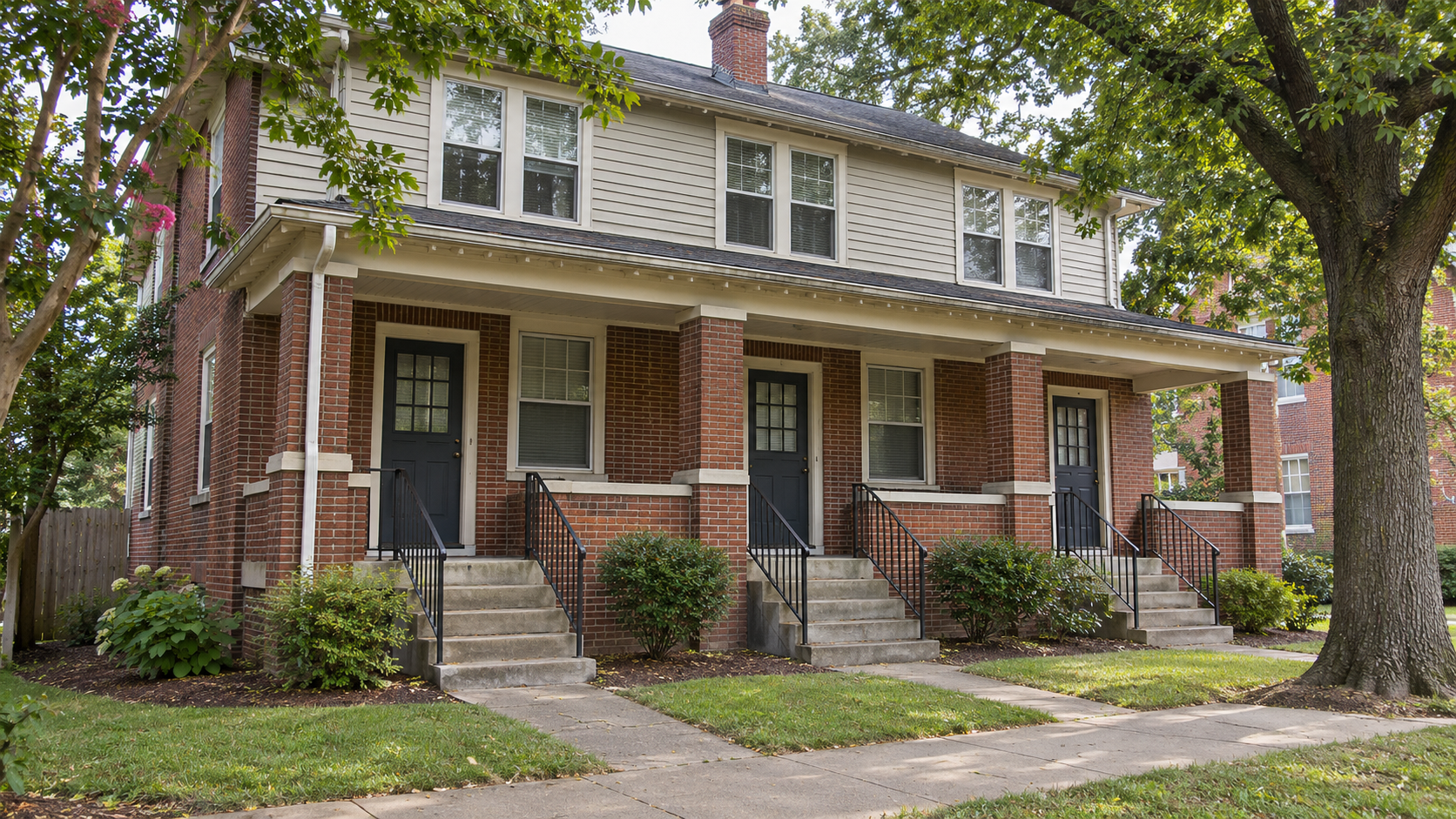
Yes. FHA financing can potentially be used to buy an eligible duplex, triplex, or fourplex in Richmond when the borrower will genuinely occupy the property as a principal residence. The key underwriting difference is that three- and four-unit properties face an FHA self-sufficiency test that a duplex does not.
PMI James River's Richmond real estate investment services help buyers test financing and rental assumptions together. Our guide to finding good real estate investment deals in Richmond covers the broader acquisition question: whether purchase price, supportable rent, condition, operating costs, and financing support the buyer's actual objective.
Small multifamily property can create an attractive combination of owner housing and rental income, but the extra units also add leases, turnover, occupied-space maintenance, utility arrangements, and building-level expenses. FHA approval and investment quality therefore need to be tested separately.
Key Takeaways
- HUD's basic FHA 203(b) program can finance eligible one- to four-unit principal residences with approximately 96.5% financing for an eligible borrower.
- A duplex does not face the specific FHA self-sufficiency test that applies to three- and four-unit properties.
- For a triplex or fourplex, PITI divided by monthly net self-sufficiency rental income may not exceed 100%.
- The self-sufficiency calculation uses appraiser-supported fair market rent from all units, including the owner unit, less the greater of the appraiser's vacancy and maintenance estimate or 25% of fair market rent.
- The lender's qualifying-income calculation and the property's real operating performance are different analyses. Both matter.
FHA's Basic Property Limit Is One to Four Units
HUD's Basic Home Mortgage Loan 203(b) program states that eligible properties include one- to four-unit structures and that an eligible borrower can receive approximately 96.5% financing. The program is for a principal residence, so the owner-occupancy requirement remains central.
Our FHA house-hacking guide for Richmond covers that broader strategy and the 60-day occupancy framework.
A Duplex and a Fourplex Do Not Underwrite the Same Way
| Property Type | FHA Difference | Main Acquisition Questions |
|---|---|---|
| Duplex | No three- to four-unit self-sufficiency test. | Supportable rent for the other unit, owner-unit availability, utilities, condition, expenses, and reserves. |
| Triplex | Three- to four-unit self-sufficiency test applies. | Appraiser-supported rents, self-sufficiency, unit condition, tenancy files, operating expenses, and liquidity. |
| Fourplex | Three- to four-unit self-sufficiency test applies. | Same core issues as a triplex, with another rental unit and another set of operating assumptions to verify. |
This financing distinction should not be confused with the broader investment decision between property types. PMI James River's live single-family versus multifamily investing guide compares asset-type economics and operating tradeoffs rather than FHA underwriting.
How the Three- and Four-Unit Self-Sufficiency Test Works
The current FHA Single Family Housing Policy Handbook 4000.1 requires a self-sufficiency rental income test for three- and four-unit properties.
HUD states that the property's principal, interest, taxes, and insurance, or PITI, divided by monthly net self-sufficiency rental income may not exceed 100%. In practical terms, the net rental income used for this test must be at least as large as PITI.
For this calculation, HUD instructs the lender to use the appraiser's estimate of fair market rent from all units, including the unit the borrower will occupy, then subtract the greater of the appraiser's estimate for vacancies and maintenance or 25% of fair market rent.
For example, if the appraiser estimates total fair market rent of $7,200 per month across a fourplex and the applicable deduction is 25%, the deduction is $1,800 and monthly net self-sufficiency rental income is $5,400. Under the test, PITI could not exceed $5,400.
That is why a fourplex can look excellent on a listing sheet and still fail FHA underwriting. Purchase price, interest rate, taxes, insurance, and appraiser-supported rent all affect the result.
Rental Income for Qualification Is a Separate Calculation
The self-sufficiency test is not the same thing as the lender's calculation of the borrower's qualifying income. Current FHA policy can allow eligible rental income from the subject property to be considered when the required documentation and underwriting standards are met, but the lender still determines which income can be used for the borrower and transaction.
Existing leases may help document current rents while the appraisal supplies market-rent information. The correct treatment can depend on the property's occupancy, the borrower's rental history, and the FHA underwriting path being used. The buyer should ask the lender to show the actual transaction-specific worksheet rather than assume that all scheduled rent will be added to personal income.
That lender calculation should also remain separate from the buyer's investment underwriting. A property can satisfy FHA's mortgage rules and still have weak real-world cash flow after vacancy, utilities, maintenance, management, turnover, and capital expenses.
Occupied Units and Property Condition Still Need Their Own Due Diligence
A small multifamily property may already have residents in some or all units. Existing occupancy can be useful because it may provide rental income immediately after closing, but the buyer still needs the tenancy file. PMI James River's live tenant-occupied acquisition checklist covers leases, deposits, payment records, notices, condition documentation, and the management handoff.
If the unit the buyer plans to occupy is itself rented, our Virginia FHA tenant-occupied property guide explains how the 60-day FHA occupancy requirement interacts with the existing tenancy.
The physical property needs separate review too. The Consumer Financial Protection Bureau explains that a home inspection and an appraisal serve different purposes. The appraisal supports the lender's valuation process, while an independent inspection helps the buyer understand the property's condition.
For a duplex, triplex, or fourplex, the buyer should also verify the legal unit count and investigate property-specific questions such as prior work, utility configuration, and visible building-system issues. Local parcel, zoning, permit, and inspection records can surface questions worth resolving, but they do not replace a physical inspection.
FHA Approval Is Not the Same as a Good Rental Acquisition
FHA underwriting answers whether the mortgage can meet FHA requirements. It does not answer whether the Richmond property is an attractive rental investment.
The operating model should include supportable rent for each rental unit, vacancy, taxes, insurance, owner-paid utilities, routine maintenance, property management, turnover, near-term capital work, and adequate post-closing liquidity. Confirm any lender-specific reserve requirement separately.
PMI James River's operating rule is to evaluate the complete property-level profile. A lower down payment can improve capital efficiency, but it does not change the roof, plumbing, utility bills, taxes, tenant files, or future repairs the owner will inherit.
Frequently Asked Questions
Can You Buy a Fourplex With an FHA Loan?
Potentially, yes. HUD's basic FHA 203(b) program allows eligible one- to four-unit structures. The borrower must meet FHA requirements and genuinely occupy the property as a principal residence.
Does a Duplex Have to Pass the FHA Self-Sufficiency Test?
No. The specific self-sufficiency test described in the FHA handbook applies to three- and four-unit properties.
Does the Owner's Unit Count in the Self-Sufficiency Rent Calculation?
Yes. HUD instructs the lender to use the appraiser's estimate of fair market rent from all units, including the unit the borrower chooses for occupancy, before applying the vacancy and maintenance deduction.
Does Current Tenant Rent Automatically Determine the FHA Rental-Income Calculation?
No. Existing leases can be important documentation, but the lender applies the current FHA rules to determine which rental income can be used for qualification and how the self-sufficiency test is calculated. The buyer should ask to see the actual rent inputs and worksheet for the transaction.
Is an FHA Appraisal a Substitute for a Home Inspection?
No. An appraisal and an independent home inspection serve different purposes. Buyers should use an inspection and any appropriate specialist evaluations to understand property condition before closing.
More Units Can Improve the Opportunity, but They Add More Variables
A duplex, triplex, or fourplex can be a compelling way to combine owner occupancy with rental income. FHA's one- to four-unit eligibility can make that strategy accessible to buyers who genuinely intend to live in the property.
The strongest deal is not necessarily the building with the most units. A triplex or fourplex must clear the additional self-sufficiency test, and every property still needs supportable rents, manageable expenses, sound condition, adequate liquidity, and an owner-occupancy plan that can actually be executed.
For a Richmond buyer testing a specific duplex, triplex, or fourplex, PMI James River can prepare a property-specific rental analysis to help establish supportable rent and pressure-test the operating assumptions behind the purchase.
Published: November 19, 2026