
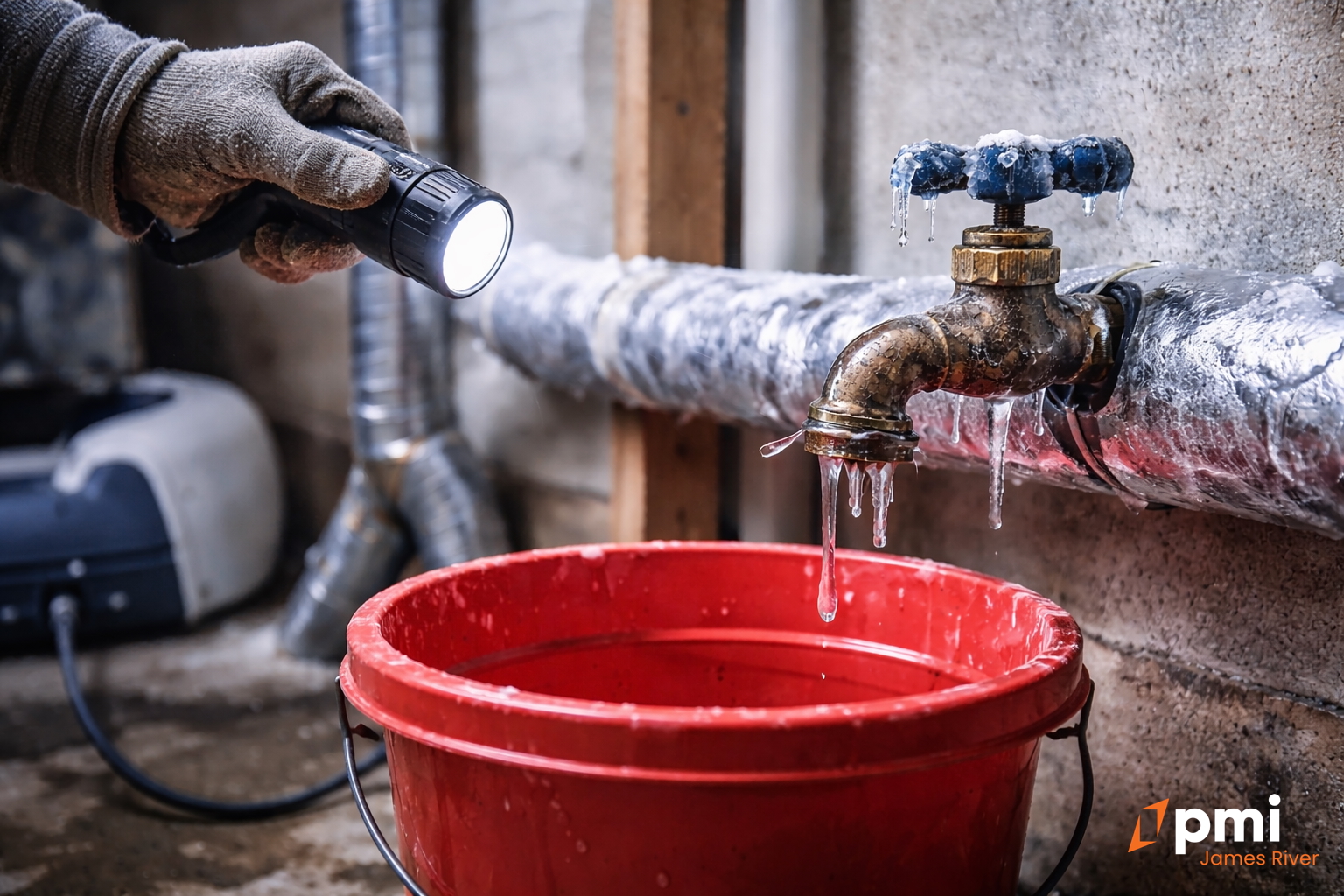
Richmond winters can include short below-freezing windows that change maintenance priorities quickly. Plumbing that seemed fine the week before can become vulnerable, and a heating complaint that was manageable can become time-sensitive once outdoor temperatures fall.
The best winter plan is not a longer checklist. It is a set of decisions made before the weather compresses the timeline. PMI James River's rental maintenance coordination process is built around that idea, while the broader proactive property maintenance framework explains why early action usually gives owners more options than emergency response.
This winter plan is for rental owners across Richmond City, Henrico County, Chesterfield County, and Hanover County. The property-specific weak point may differ, but the operating goal is the same: protect water lines, keep heat reliable, catch moisture early, and document fast-moving repairs well enough that the next decision starts with facts.
Key Takeaways
- Winter maintenance should prioritize failures that can cause secondary damage or loss of essential services, especially frozen plumbing, active water intrusion, and loss of heat.
- Richmond Public Utilities identifies outdoor plumbing, unheated basements, crawl spaces, garages, and other exposed pipe locations as common freeze vulnerabilities.
- A weak-heat complaint needs better intake information, not an automatic assumption that the system has failed or that the resident is simply uncomfortable.
- Pre-freeze communication should make water shutoff locations, vulnerable plumbing, and resident reporting expectations clear before an emergency.
- Good closeout notes reduce repeat dispatch because the next person can see what was reported, what was found, what changed, and what still needs monitoring.
In This Guide
- Why Winter Maintenance Gets Expensive Fast
- Map the Property's Winter Weak Points
- Tier 1: Protect Plumbing Before a Freeze
- Tier 2: Separate No Heat From Weak Heat
- Tier 3: Catch Water and Access Problems Early
- Build a Winter Intake and Closeout Standard
- Two Winter Scenarios That Change the Response
- Common Winter Maintenance Mistakes
Why Winter Maintenance Gets Expensive Fast
Winter changes the cost of delay. An owner may still have time to compare options when a marginal condition is discovered during ordinary weather. During a cold snap, the priority can shift to restoring heat, preventing frozen plumbing, stopping water, or protecting the property from secondary damage.
Three costs tend to stack together:
- Compressed scheduling. A routine service window can disappear when many properties need the same trade at the same time.
- Secondary damage. The first repair may be small, but water can add drying, drywall, flooring, cabinet, or finish work if the underlying problem is not controlled quickly.
- Repeat dispatch. Thin intake notes make it easier for the wrong trade, incomplete scope, or unresolved symptom to create another visit.
PMI James River has received resident referrals specifically tied to fast maintenance handling. That is a useful reminder for owners: winter response quality affects more than the immediate invoice. A clear process can also reduce resident frustration, repeated access, and uncertainty about whether a problem is actually resolved.
The Richmond rental maintenance seasons guide places winter in the larger annual cycle. Fall is where pre-freeze setup should happen. Winter is where that preparation is tested.
Map the Property's Winter Weak Points
A useful winter plan starts with the property, not a generic checklist. The owner or manager should know where the home is most likely to lose heat, expose plumbing to cold, or take on water.
Freeze-risk locations.
- Exterior-wall plumbing, including under-sink supplies and shutoffs.
- Water lines in crawl spaces, unheated basements, attics, garages, and other unconditioned areas.
- Garage-adjacent laundry or utility plumbing.
- Outdoor hose connections and hoses that remain attached.
Heating trouble spots.
- Rooms that repeatedly lag behind the thermostat setting.
- Multi-level homes where one floor is consistently colder than another.
- Systems with a history of short cycling, weak airflow, or cold-weather callbacks.
- Returns, filters, thermostats, or control settings that should be checked before assuming a major equipment failure.
Water-entry locations.
- Roof penetrations, valleys, flashing transitions, and previously repaired roof areas.
- Gutters and downspouts that still carry fall leaf debris.
- Window and door perimeters with a history of wind-driven rain entry.
- Crawl spaces, basements, and lower wall areas where past moisture has appeared.
This property-specific map is especially useful across Richmond's varied housing stock. A Richmond City home with older additions may have different vulnerable plumbing and roof transitions than a newer Chesterfield home. A Hanover crawl-space home may need a different freeze and moisture check than a Henrico townhome with room-to-room airflow complaints. The workflow should stay consistent even when the weak point changes.
Tier 1: Protect Plumbing Before a Freeze
Frozen plumbing deserves Tier 1 attention because prevention is usually simpler than responding after a line has frozen or burst. In January 2026, the City of Richmond Department of Public Utilities published winter pipe-protection guidance identifying outdoor pipes, unheated basements, crawl spaces, and garages as especially vulnerable when temperatures fall below 32°F.
For rental owners and property managers, that guidance translates into a short pre-freeze operating plan:
- Disconnect outdoor hoses and confirm exterior plumbing is prepared for cold weather.
- Identify exposed or poorly protected water lines before the coldest nights arrive.
- Make sure the resident knows where the home's main water shutoff is and how to report a suspected freeze or leak immediately.
- Where vulnerable sink plumbing sits against an exterior wall, communicate any property-specific cold-weather steps before the event, not after water flow stops.
- For a vacant property or an owner who will be away, confirm heat remains on. Richmond DPU advises keeping the thermostat no lower than 55°F when away during cold weather.
A sudden drop in water flow should not be treated as a routine inconvenience during freezing weather. It may indicate a frozen section of pipe. Richmond DPU advises contacting a licensed plumber when a pipe has burst or the frozen location cannot be found.
Key point: The most useful freeze plan is property-specific. Know the vulnerable runs, the shutoff location, the resident communication step, and who gets called before the temperature drops.
Tier 2: Separate No Heat From Weak Heat
No heat and weak heat are not the same maintenance event. Virginia law makes the distinction important because landlords generally must maintain supplied heating systems in good and safe working order and supply heat in season. The current baseline appears in Virginia Code § 55.1-1220. PMI James River's Virginia landlord maintenance responsibilities guide explains the broader habitability and repair framework.
A no-heat report during cold weather should be classified quickly. A weak-heat report needs enough facts to determine whether the problem is system performance, airflow, controls, distribution, or another condition affecting the room.
A useful winter intake captures:
- thermostat setpoint and observed indoor temperature;
- which rooms or floors are affected;
- whether the system is running continuously, cycling, or not starting;
- whether supply air is moving in the affected area;
- whether the problem appears only during colder outdoor conditions; and
- whether the same complaint has happened before.
Simple airflow information matters. The U.S. Department of Energy Building Science Education program notes that a dirty or clogged filter can reduce airflow and increase furnace run time. That does not mean every weak-heat complaint is a filter problem. It means basic evidence should be collected before the technician arrives so the first visit begins with better information. The deeper system-level issues belong in the Richmond HVAC maintenance guide.
Tier 3: Catch Water and Access Problems Early
Winter water problems are not limited to frozen pipes. Rain, clogged drainage, roof defects, and wind-driven water can still create damage during colder months. The right response is to document where the water appeared and trace the mechanism instead of treating the stain itself as the repair.
After a winter rain or ice event, time-sensitive observations include:
- new ceiling or wall staining;
- wet drywall around windows or exterior walls;
- gutter overflow or downspouts discharging where water collects against the building;
- new crawl-space or basement moisture;
- loose exterior components, railings, or steps that make access less reliable; and
- exterior lighting failures around commonly used entries.
Snow and ice are less frequent in Richmond than in colder markets, which can make preparation easier to postpone. Owners should decide in advance who is responsible for property-specific snow and ice tasks, what the lease says, and how common or shared areas will be handled when applicable. The goal is to avoid discovering the responsibility gap after conditions have already changed.
Build a Winter Intake and Closeout Standard
Winter maintenance becomes expensive when the team has to rediscover the same facts. PMI James River treats a maintenance request as a symptom report, not a diagnosis. The request should move through a consistent process: clarify the symptom, classify urgency, decide whether safe troubleshooting is appropriate, route the right vendor when needed, control the scope, and document closeout.
The broader rental maintenance operations framework explains those controls in detail. For winter events, four records are especially useful:
- Initial condition. What the resident reported, when it was reported, and any photo, reading, or video that shows the symptom.
- Classification. Why the issue was treated as emergency, urgent, or routine based on what was known at that point.
- Vendor finding. What the technician found, not just a vague note that the issue was "fixed."
- Closeout. What was repaired, what was tested, and whether monitoring or additional work remains.
This is not paperwork for its own sake. A clean file helps prevent the second technician from starting at zero, helps the owner understand why a decision was made, and makes it easier to distinguish a new failure from an incomplete prior repair.
Two Winter Scenarios That Change the Response
Scenario 1: The Heat Runs, but the Home Does Not Hold Temperature
The resident reports that the system runs, but one floor or several rooms remain cold. The weak response is to classify the issue as a comfort preference without collecting evidence. The better path is to record the thermostat setting, actual indoor reading, rooms affected, time of day, airflow observations, and whether the pattern becomes worse as outdoor temperatures fall.
That information does not diagnose the system. It gives the HVAC technician a better starting point and makes it easier to distinguish a control, airflow, distribution, equipment, or building-envelope issue.
Scenario 2: Water Pressure Drops During a Freeze, but No Leak Is Visible
A resident turns on a faucet and gets much less flow than normal during freezing weather. That should trigger a freeze-risk check rather than a routine plumbing queue. If a frozen section is suspected, the priority is to protect the property, identify whether water is escaping, and get qualified help when the location is inaccessible or a burst has occurred.
The lesson is the same in both scenarios: the symptom determines the first questions, and the evidence determines the next decision.
Common Winter Maintenance Mistakes
- Waiting for the forecast to become urgent. Hose removal, exposed-pipe awareness, heating reliability, and resident instructions should be handled before the coldest night.
- Treating every heating complaint the same. No heat requires a different response from uneven or weak heat, but both need specific intake information.
- Assuming a small water stain is only cosmetic. The stain is evidence. The repair decision should focus on whether the moisture source is active and what materials were affected.
- Closing a ticket when the vendor leaves. The file should show the diagnosis, completed scope, verification, and any follow-up still required.
- Ignoring fireplace and chimney readiness. The U.S. Fire Administration recommends annual professional cleaning and inspection of heating equipment and chimneys. If a rental has a fireplace or wood-burning appliance, its service status should be known before regular winter use.
FAQ
What Should a Richmond Rental Owner Prioritize Before a Freeze?
Start with exposed plumbing, outdoor hoses and hose connections, heat reliability, the main water shutoff, and clear resident reporting instructions. The property-specific weak points matter more than a generic list.
Should Winter Prep Focus More on HVAC or Plumbing?
Both, but for different reasons. Plumbing freeze prevention reduces the chance of a water-loss event. Heating reliability matters because Virginia law requires landlords to supply heat in season, and a failure can become time-sensitive quickly during cold weather.
What Information Should Be Collected for a Weak-Heat Complaint?
Capture the thermostat setpoint, observed indoor temperature, affected rooms or floors, whether the system is running, the time of day, airflow observations, and whether the same pattern has happened before. Those details help the technician begin with evidence instead of a vague "not keeping up" report.
Do Gutters Still Matter in a Richmond Winter?
Yes. If leaf debris remains in the gutters, verify that water can drain freely during winter rain. Properties with a history of gutter overflow, roof-edge leakage, basement moisture, or crawl-space water deserve extra attention.
What Should Happen After a Winter Repair Is Completed?
The closeout should state what was found, what was repaired, whether the repair was tested, and whether any monitoring or follow-up remains. That record becomes especially useful if the same symptom returns during the next cold snap.
Winter Maintenance Works Best Before the Emergency
Richmond winters do not require owners to treat every cold day as a crisis. They do require a property-specific plan for the few conditions that can escalate quickly: frozen plumbing, loss of heat, water intrusion, unsafe access, and repeat failures that were never fully closed out.
The practical advantage of proactive winter maintenance is more control. Owners get more time to make good decisions, residents get clearer communication, and vendors get better information before they arrive. For owners who want that process handled consistently, PMI James River's Richmond rental maintenance services coordinate intake, vendor response, documentation, and follow-through across the Richmond Metro.
Published: January 1, 2026
Updated: August 22, 2026