
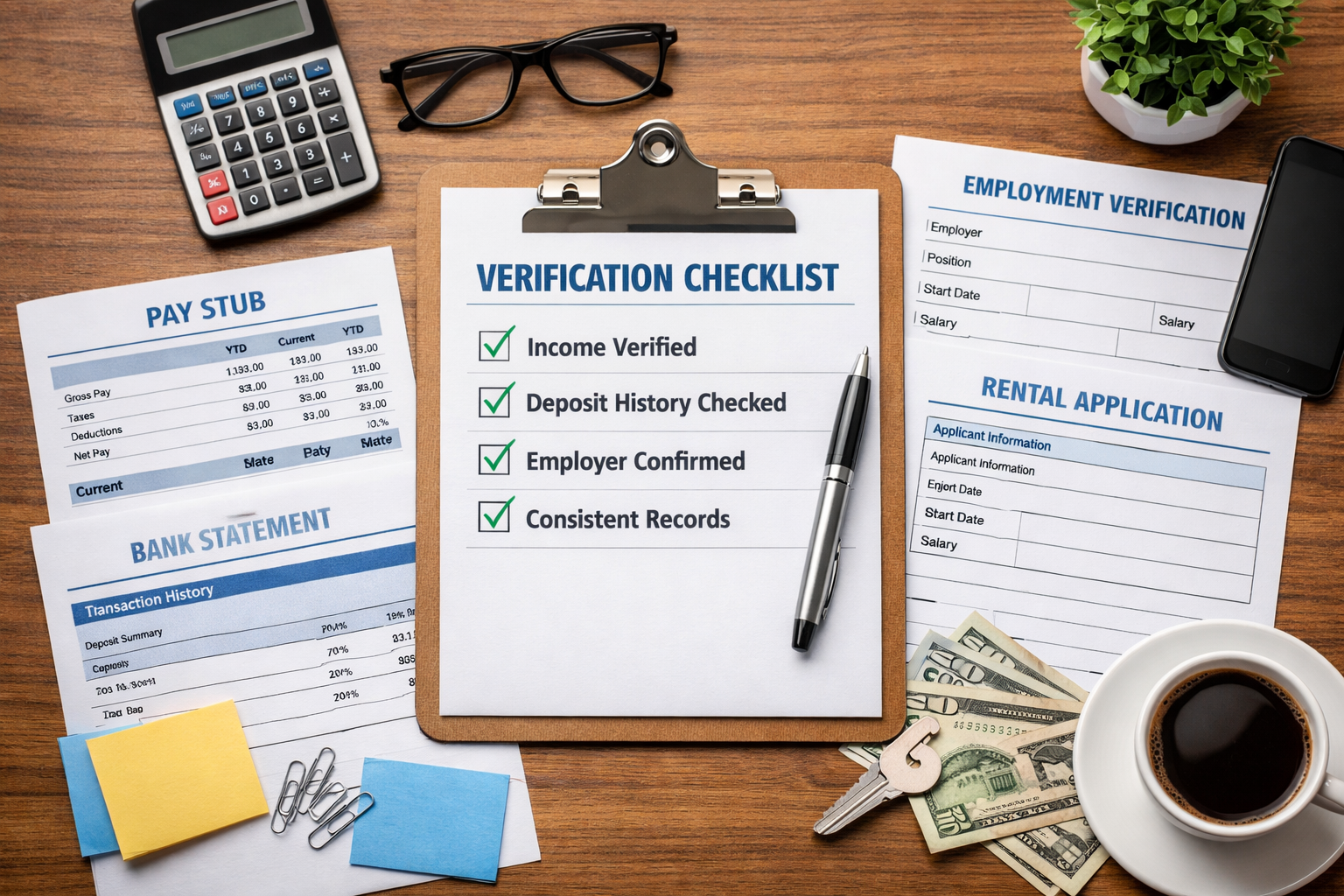
A pay stub can look legitimate and still be altered, outdated, or fabricated. For a Virginia rental owner, the safest response is not to become a document-forensics expert. It is to use a screening process that does not let one PDF carry the decision.
PMI James River treats income verification as one part of a broader tenant screening and risk-control process. The question is whether the income claim can be corroborated through sources that agree with one another, not whether a pay stub looks polished.
Fake pay stubs are also one narrow form of rental fraud in Richmond and Virginia. Keeping that narrow role matters. This article focuses on how an owner or property manager should respond when wage documentation may not be reliable.
Key Takeaways
- A pay stub is evidence of an income claim, not sufficient verification by itself.
- Formatting problems and unusual details should trigger corroboration, not an automatic accusation of fraud.
- The strongest files reconcile claimed pay, actual deposit patterns, employment status, and the applicant's stated pay cadence.
- A consistent proof standard is more defensible than deciding which applicants deserve extra scrutiny based on impressions.
- If a consumer report contributes to a denial or less favorable rental terms, federal adverse-action rules can apply.
In This Guide
- Why a pay stub cannot carry the decision
- What income verification should prove
- Red flags should trigger corroboration
- The PMI James River verification ladder
- What to do when the file does not reconcile
- Fair Housing and FCRA guardrails
- A simple decision path for suspect income documents
Why A Pay Stub Cannot Carry The Decision
The problem is no longer limited to crude edits. In a 2025 investigation, RentEngine reported that its team was able to buy customized pay stubs, bank statements, tax forms, identification documents, and even employer references through an online fraud network. The point is not that every clean document is suspicious. It is that appearance alone has become a weak verification method. RentEngine's investigation of fake rental application packages shows how complete a fabricated file can look.
A one-document policy therefore has a structural weakness. If the screening rule is simply "provide recent pay stubs," a fabricated stub can satisfy the form of the requirement without proving the underlying income. A better rule asks whether independent evidence tells the same story.
This distinction also prevents overreaction. A strange font, an unfamiliar payroll layout, or a small math discrepancy does not prove fraud. Legitimate payroll systems vary, deductions vary, and applicants may have ordinary explanations for an unusual document. The useful question is whether the inconsistency can be resolved through corroboration.
What Income Verification Should Prove
Income verification should answer four practical questions:
- Is the applicant currently receiving the income claimed on the application?
- Does the pay frequency match the stated employment arrangement?
- Do independent records support the amount and timing of the income?
- Does the file meet the property's written income qualification standard?
That is narrower than a full screening review. Credit, rental history, identity, and other criteria have separate jobs. The broader article on what tenant screening evaluates in practice explains how those pieces fit together.
For fake-pay-stub risk, the most useful principle is simple: verify the claim through a second source that the applicant did not create merely for the application. That may be trusted bank-linked deposit data, employer verification, payroll data, or a combination of complete source documents that reconcile with each other.
Red Flags Should Trigger Corroboration, Not An Automatic Rejection
Document review still matters. It helps identify the files that need a closer look. Useful triggers include:
- Pay-period math that does not reconcile. Year-to-date totals, hours, rates, or net amounts do not fit the stated pay cadence.
- Employer information that does not resolve cleanly. The company name, contact information, or employment details cannot be independently confirmed.
- Deposit patterns that conflict with the stub. The claimed employer, amount, or timing does not line up with the actual deposit history being relied on.
- Document-integrity issues. Misaligned text, inconsistent fonts, missing pages, cropped fields, or other editing artifacts justify asking for a complete source document.
- Resistance to the same corroboration required by the written policy. A fast move-in request is not evidence of fraud, but urgency should not change the proof standard.
The action triggered by a red flag should be stronger verification, not a character judgment. A file can fail because income remains unverified even when the housing provider cannot prove why the documents did not reconcile.
This is an important screening discipline. Owners do not need to prove that an applicant committed fraud in order to decide that the applicant has not met a documented income-verification requirement.
The PMI James River Verification Ladder
PMI James River's current public rental qualification standards require verifiable income and strongly recommend secure bank-linked verification. The published criteria also provide manual alternatives, require complete and unaltered documents, and do not accept screenshots as the substitute for source documentation.
Operationally, the verification ladder works like this:
- Start with trusted-source verification when available. Bank-linked or payroll-linked data can reduce reliance on applicant-created PDFs.
- Reconcile the source data against the claimed pay. A verified deposit is useful only if the amount, date, employer source, and pay cadence make sense together.
- Use employer verification when the file still needs confirmation. Keep the inquiry narrow and factual, such as active employment, start date, pay frequency, and compensation information the employer is authorized to confirm.
- Request additional source documents only when needed. More paperwork is not automatically better. The goal is enough independent evidence to resolve the inconsistency.
- Document the result. Record what was reviewed, what did not match, what additional verification was requested, and whether the written standard was ultimately met.
One practical lesson from PMI James River's screening work is that even trusted-source automation still needs human reconciliation. A bank connection may show that deposits are real while an automated monthly summary misstates income because weekly, biweekly, or semimonthly pay was grouped incorrectly. We reconcile the actual deposit dates and amounts against the pay cadence rather than treating a headline monthly number as self-proving.
What To Do When The File Does Not Reconcile
The most common mistake is trying to decide whether the applicant is lying. That is usually not the decision the screening policy needs to make.
The cleaner question is: Has the applicant provided verifiable income that meets the published standard?
If the answer is not yet clear, request the predefined alternative evidence available under the policy. If the evidence then reconciles, continue the screening process. If it does not, document the unresolved mismatch and decide the file under the same written criteria used for other applicants.
This approach also keeps the fake-pay-stub article from swallowing the broader subject of income screening. W-2 employees, new jobs, self-employment, gig income, benefits, and other income types need different evidence pathways. The broader income and employment verification guide is the better reference for those document combinations.
For a Richmond City, Henrico, Chesterfield, or Hanover rental, the underlying discipline does not change with the county line. The written qualification rule and the available proof pathways should be established before the file becomes difficult.
Fair Housing And FCRA Guardrails
Fraud prevention does not create a separate legal lane for subjective screening. Virginia's Fair Housing Act prohibits discriminatory rental practices based on protected characteristics. Virginia Code section 36-96.3 is the current primary state-law source.
The practical control is to define the qualification standard and acceptable verification pathways in advance. That does not mean every applicant must submit identical documents. A salaried employee, a new hire, and a self-employed applicant may need different evidence. The standard should stay consistent while the approved evidence pathway fits the income type.
The Fair Credit Reporting Act creates a separate issue when a consumer report influences the outcome. The FTC's landlord guidance on consumer reports explains an important distinction: a reference checked by the landlord's own employee is not itself a consumer report, while a report from an outside agency hired to check references can be.
If information in a consumer report plays a part in a denial or in less favorable terms, such as requiring a co-signer or a larger deposit, an adverse-action notice is required. The Consumer Financial Protection Bureau's tenant-screening guidance summarizes the notice and the applicant's rights to obtain and dispute the report.
This is why "suspected fake pay stub" should not become a loose decision category. The file should show which objective requirement was not satisfied, which source was relied on, and which notice obligations were triggered by the information used.
A Simple Decision Path For Suspect Income Documents
- Check the document against the application. Confirm employer, pay rate, pay frequency, dates, and identifying details.
- Look for a material mismatch. Separate actual inconsistencies from unfamiliar formatting or harmless variation.
- Corroborate through an independent source. Use the same approved pathway the screening policy makes available for that income type.
- Reconcile the numbers. Compare real deposit dates and amounts with the claimed pay cadence rather than relying on one summary field.
- Resolve the file against the written standard. The question is verified income, not whether the reviewer can prove intent.
- Document the decision and complete any required adverse-action process. The record should explain itself later without relying on memory.
This process makes screening faster once it is standardized. The reviewer does not have to invent a response each time a document looks unusual. The next step is already defined.
Frequently Asked Questions
Are Pay Stubs Enough To Verify Income For A Virginia Rental Application?
A pay stub can support the income claim, but it should not carry the decision by itself when the screening policy requires corroboration. Trusted deposit data, employer verification, or other approved source documents can confirm whether the claimed income is current and consistent.
What Is The Best Sign That A Pay Stub May Be Unreliable?
A material mismatch is more useful than appearance. The claimed pay amount, pay cadence, employer information, and independent deposit or employment data should tell the same story. A formatting oddity alone is not proof of fraud.
Should A Landlord Reject An Application As Soon As A Pay Stub Looks Fake?
No automatic conclusion should be based on appearance alone. The safer process is to follow the written verification pathway, request the same approved corroboration that would be used for a comparable file, and decide whether the applicant met the income-proof requirement.
Is Bank-Linked Income Verification Enough By Itself?
It can be strong evidence because it reduces reliance on uploaded documents, but the data still needs to be interpreted correctly. Pay cadence, deposit source, timing, and automated summaries should reconcile with the applicant's stated employment and income.
When Does An Adverse-Action Notice Apply?
When information in a consumer report contributes to a denial or less favorable rental terms, federal adverse-action requirements apply. The exact notice should identify the reporting company and explain the applicant's rights concerning the report.
Conclusion
Fake pay stubs are best handled as a verification problem. Visual inspection can identify inconsistencies, but it should not decide the file. Corroboration is the stronger control.
For Virginia rental owners, the durable standard is a written income rule, predefined proof pathways, objective triggers for additional verification, and a record that shows exactly how the final decision was reached. In Richmond City, Henrico, Chesterfield, and Hanover, that same discipline lets a screening process move quickly without letting urgency lower the standard.
Next Step
Owners who want screening handled through a documented, repeatable process can review PMI James River's tenant screening service for Richmond-area rentals. The value is not one more report. It is a process that verifies the claim, records the evidence, and applies the same decision framework from one application to the next.
Published: March 17, 2026
Updated: August 22, 2026