
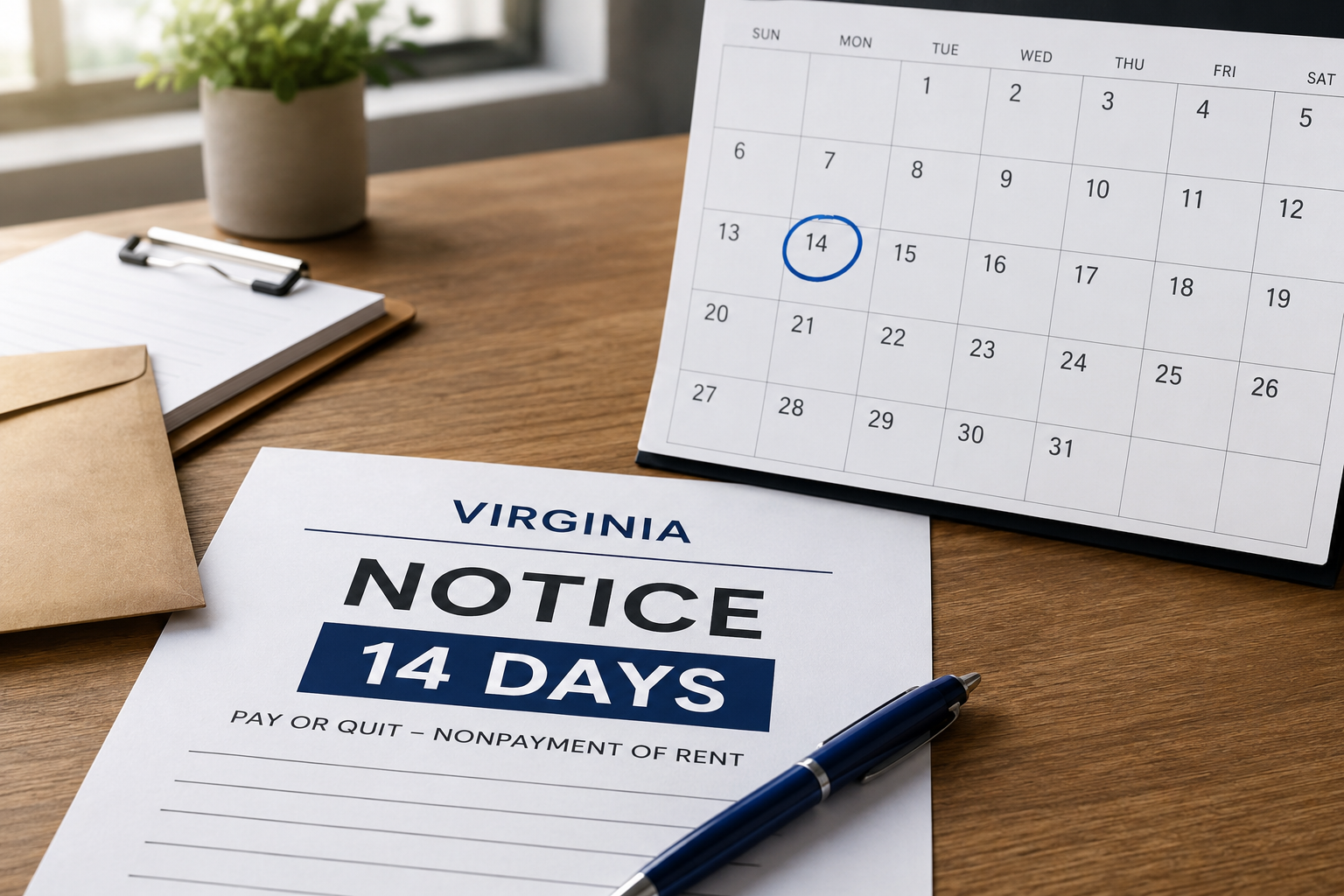
Virginia's 14-day nonpayment notice rule is now in effect. Since July 1, 2026, a landlord handling an ordinary residential tenancy covered by the Virginia Residential Landlord and Tenant Act must give the tenant 14 days after written notice is served to pay unpaid rent before terminating the rental agreement under Virginia Code § 55.1-1245(F).
For Richmond-area owners, PMI James River's eviction support starts with getting that first notice and the documentation behind it right. Owners who need the full sequence after a notice expires can use our Virginia eviction process guide.
Key Takeaways
- Virginia's standard nonpayment notice period is now 14 days, not five.
- The 14-day period runs after the required written notice is served.
- The same 14-day period also applies when a rent check or electronic transfer is rejected for insufficient funds, or when a stop-payment order is placed in bad faith.
- Electronic notice is permitted only when the rental agreement provides for it, and the sender must retain proof of electronic delivery.
- Owners should retire old five-day forms, serve promptly once an account is delinquent, and keep the rent ledger and notice record synchronized.
- Additional nonpayment-notice requirements are already scheduled for July 1, 2027, so forms will need another review before then.
In This Guide
- What Virginia Law Requires Now
- Two Nonpayment Situations Covered
- Service and Documentation Still Matter
- What Did Not Change
- How PMI James River Handles the Longer Window
- What Owners Should Update Now
- What Changes Again in 2027
What Virginia Law Requires Now
Virginia Code § 55.1-1245(F) now provides that when rent is unpaid when due, a landlord may terminate the rental agreement for nonpayment only if the tenant fails to pay within 14 days after written notice is served. The notice must tell the tenant about the nonpayment and the landlord's intention to terminate the rental agreement if the rent is not paid within that 14-day period.
The practical change is simple but important. A five-day nonpayment form no longer states the current statutory cure period for notices served on or after July 1, 2026. Virginia REALTORS® likewise advised property managers to revise five-day forms and noted that an outdated form can create a procedural defect in an unlawful detainer action. Owners can review that Virginia REALTORS® legal update alongside the statute.
Key point: Informal reminders do not replace the statutory notice. If an owner wants the nonpayment termination timeline moving, the notice process has to start promptly and be documented.
Two Nonpayment Situations Covered
The current statute addresses two common nonpayment situations within subsection F:
- Ordinary unpaid rent. If rent is unpaid when due, the written notice gives the tenant 14 days to pay before the landlord may terminate the rental agreement and proceed toward possession.
- A failed or stopped rent payment. If a rent check is returned for insufficient funds, an electronic funds transfer is rejected for insufficient funds, or a stop-payment order is placed in bad faith, the tenant also receives 14 days after written notice to cure. In that situation, the statute specifies acceptable cure methods such as cash, cashier's check, certified check, or a completed electronic funds transfer.
For ordinary residential tenancies covered by the VRLTA, the 14-day timing in § 55.1-1245(F) is not written as a different period for a one-home owner versus a larger portfolio owner. The Act generally applies statewide to single-family and multifamily dwelling units, although § 55.1-1201 identifies specific excluded occupancies and special lodging rules.
Service and Documentation Still Matter
Changing the cure period did not make service mechanics optional. Under Virginia Code § 55.1-1202, electronic notices may be used when the rental agreement provides for electronic notice, a tenant may elect paper notice, and the sender must retain sufficient proof of electronic delivery.
Assisted housing can add another notice-content requirement. A private landlord serving a termination notice on a tenant receiving Housing Choice Voucher or other covered tenant-based rental assistance must include the statewide legal aid telephone number and website address on the first page of the notice. That requirement is already in the current version of § 55.1-1202.
This is why a reliable notice process needs more than the correct number of days. The owner should be able to show what was served, when it was served, how it was delivered, what the ledger showed at the time, and what payments came in afterward.
What Did Not Change
| Issue | Current Rule |
|---|---|
| Nonpayment cure period | 14 days after written notice is served under § 55.1-1245(F). |
| Court process | The notice is still the front end of the process. Expiration of the notice does not let the owner bypass the lawful possession process. |
| Self-help | A landlord still cannot simply lock out a tenant, interrupt essential services, or make the premises unsafe to force possession. |
| Redemption | Virginia's statutory right of redemption can still stop a nonpayment eviction when the required amounts are paid within the conditions set by law. |
Virginia gives tenants substantial remedies when a landlord willfully excludes them without court authority, interrupts essential services, or makes a dwelling unsafe. Those remedies are set out in § 55.1-1243.1.
The 14-day rule also did not erase redemption rights. Under § 55.1-1250, a tenant in a nonpayment case may have opportunities to stop the eviction by paying the amounts required by statute, including a payment made no less than 48 hours before a scheduled eviction when the statutory conditions are met.
How PMI James River Handles the Longer Window
The longer notice period makes delay before service more expensive. At PMI James River, the operating rule is to serve the nonpayment notice promptly once the account is delinquent under the lease, then use the 14-day window for any payment conversation instead of delaying service while trying to work something out informally.
That approach protects the owner's calendar without preventing communication. If a resident catches up, the file reflects it. If the account does not cure, the notice timeline has already been running. PMI James River also logs notices and payments in Rentvine so the notice record and ledger can be reviewed together if the matter escalates.
A consistent rent collection process is the operational layer behind the legal notice. Strong tenant screening remains the earlier risk-control layer that helps reduce avoidable payment problems before a lease begins.
What Owners Should Update Now
Owners should treat the July 1, 2026 change as a systems update, not just a form edit.
- Retire five-day forms. Remove outdated nonpayment templates from shared drives, property-management software, staff folders, and saved emails.
- Check notice delivery language. Confirm the lease and notice procedure support the delivery method actually being used, especially for electronic notices.
- Check rental-assistance status. A termination notice for a tenant receiving covered tenant-based rental assistance has additional first-page legal aid requirements.
- Define the trigger. Decide exactly when an account is considered delinquent under the lease and who is responsible for serving the notice.
- Preserve proof. Keep the notice, service record, ledger, returned-payment information, and later payments together.
- Do not improvise after service. Partial payments, redemption, payment arrangements, and a later court filing can affect the path forward. Keep those events documented against the same file.
The goal is not aggressive eviction. It is predictable enforcement. A clean process gives a resident a defined opportunity to cure while preventing avoidable owner-side delay.
What Changes Again in 2027
Virginia has already enacted another set of nonpayment-notice changes for July 1, 2027. The future version of § 55.1-1202 adds a requirement that a nonpayment termination notice include a written statement of charges and payments for the tenancy or the previous 12 months, whichever is shorter, along with specified additional amounts. The future version of § 55.1-1245 also adds a payment-plan rule for certain landlords owning more than four Virginia rental dwelling units when the statutory conditions are met.
Those provisions are not yet the current 2026 procedure. Owners should keep using the law in force now, but calendar another notice-template review before July 1, 2027. This page should be updated again when those requirements become effective.
Frequently Asked Questions
When Did Virginia's 14-Day Pay or Quit Notice Take Effect?
July 1, 2026. The current version of § 55.1-1245(F) gives the tenant 14 days after written notice is served to pay unpaid rent before the landlord may terminate the rental agreement for nonpayment.
Does the 14-Day Rule Apply to an Owner With One Rental House?
For an ordinary residential tenancy covered by the VRLTA, yes. Section 55.1-1245(F) uses the same 14-day nonpayment period without creating a shorter period for small portfolio owners. Specific occupancies outside the standard VRLTA framework can be treated differently under § 55.1-1201.
Can a Landlord Still Use a Five-Day Form?
Not for a current nonpayment notice governed by § 55.1-1245(F). A five-day form states less cure time than the current statute requires. The safer operational response is to retire the old template rather than trying to repair it case by case.
Can the Notice Be Sent by Email?
Electronic notice can be used if the rental agreement provides for it. Section 55.1-1202 also requires the sender to retain sufficient proof of electronic delivery, and a tenant may elect to send and receive notices in paper form.
What Happens After the 14 Days Expire?
If the rent remains unpaid and the statutory requirements are satisfied, the landlord may terminate the rental agreement and proceed toward possession. The owner still has to use the lawful court process rather than self-help. The broader steps are covered in our Virginia eviction process guide linked above.
Can a Tenant Still Pay After an Eviction Case Is Filed?
Potentially. Virginia's redemption statute can allow a nonpayment eviction to be stopped by payment of the required amounts at specified stages. Because the exact amount and timing matter, owners should keep the ledger current and document every payment received after notice and filing.
Conclusion
The 2026 change is straightforward: five days became 14. The management challenge is making sure every form, service method, ledger entry, and follow-up step works from the same current rule.
For Richmond City, Henrico, Chesterfield, and Hanover rental owners, a disciplined process can protect cash flow without turning every late payment into a crisis. PMI James River handles rent collection, notice tracking, documentation, and escalation as part of a broader management system. Learn more about our Richmond property management services.
Published: June 6, 2026
Updated: August 22, 2026